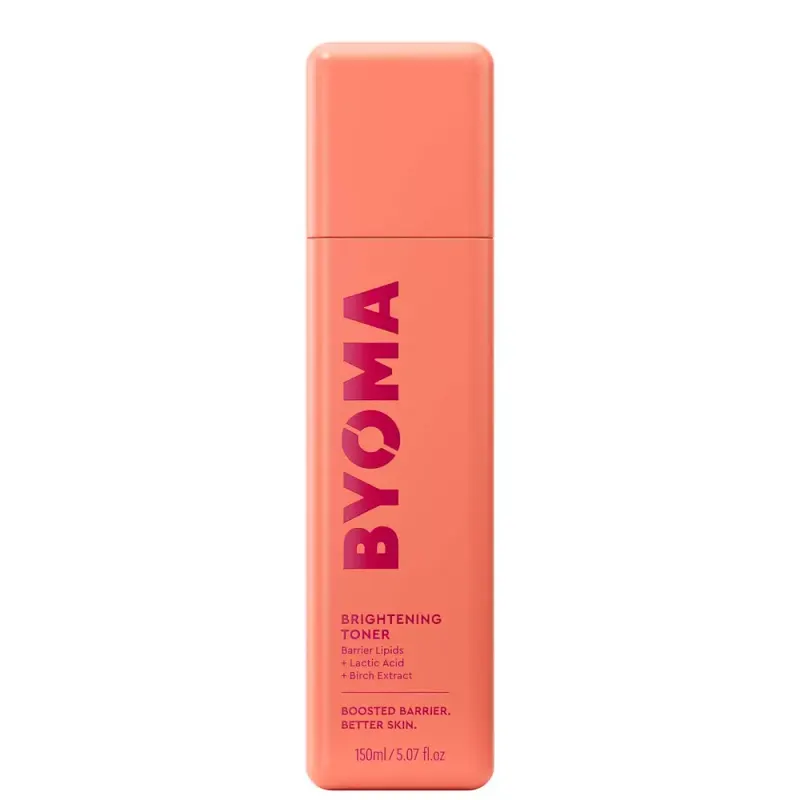
BYOMA Brightening Toner by BYOMA
BYOMA

BYOMA Brightening Toner

Toners

Safety score

Pregnancy-focused assessment

Low Risk77/100
Higher concernLower concern

One or more ingredients have a low-risk flag in MamaSkin's current assessment. Review the notes and your own circumstances.

Formula and assessment check

Ingredient safety review updated 9 December 2025. Product formulas can change, so compare the ingredients shown here with the packaging you have.

Report a formula mismatch

Ingredient breakdown

See how the listed formula falls across MamaSkin's pregnancy-focused risk bands.

16

No known risks

3

Low risk

0

Medium risk

0

High risk

Ingredients

Ingredients with a higher risk flag appear first, followed by the rest of the formula.

Salix Alba Bark Extract

Low Risk

Willow bark is a salicin-containing botanical material. Its composition and delivered salicylate exposure vary by species, plant part, extraction method and concentration, so a cosmetic extract should not be treated as dose-equivalent to a stated concentration of salicylic acid. MamaSkin retains Low Risk as a conservative family policy for ordinary topical cosmetic use; this does not cover oral willow-bark medicines, concentrated preparations, large-area use or salicylate allergy.

Sources: EMA/HMPC: Salicis cortex assessment and monograph materials https://www.ema.europa.eu/en/medicines/herbal/salicis-cortex; CIR 2026 review materials for Salix alba-derived cosmetic ingredients https://www.cir-safety.org/panelbook/safety-assessment-salix-alba-willow-derived-ingredients-used-cosmetics
Lactic Acid

Low Risk

Endogenous alpha-hydroxy acid and humectant; at modest cosmetic concentrations (≈5% and below, and generally <10%) topical lactic acid is considered compatible with pregnancy. Main risks are local irritation and increased photosensitivity rather than systemic toxicity or fetal effects.

Sources: MotherToBaby: Topical acne treatments in pregnancy and breastfeeding https://www.ncbi.nlm.nih.gov/books/NBK582985/

Mandelic Acid

Low Risk

Aromatic alpha-hydroxy acid with larger molecular size than glycolic; penetrates more slowly and is less irritating. Topical use in cosmetic-strength peels and serums is generally regarded as low risk in pregnancy, with irritation and photosensitivity as the main concerns when overused.

Sources: MotherToBaby: Topical acne treatments in pregnancy and breastfeeding https://www.ncbi.nlm.nih.gov/books/NBK582985/

Show all (19)

Water

No Known Risks

Sodium Lactate

No Known Risks

Humectant and buffer that also forms part of the skin's natural moisturising factor. Reviewed cosmetic safety sources support topical cosmetic use; irritation and sun-sensitivity considerations relate more to formula context than to pregnancy-specific risk.

Sources: CIR: Safety Assessment of Alpha Hydroxy Acids as Used in Cosmetics; CIR: PCA and Its Salts as Used in Cosmetics; EU CosIng / cosmetics regulatory inventory

Dipropylene Glycol

No Known Risks

Dipropylene glycol is used as a solvent and carrier in cosmetics; topical exposure is low and it has no known pregnancy or breastfeeding concerns at cosmetic concentrations.

Sources: CIR; EU/UK Cosmetics Regulation

Glycerin

No Known Risks

Glycerin is a widely used humectant that supports hydration and the skin barrier, with a long safety record and no known pregnancy or breastfeeding concerns in topical cosmetic use.

Sources: CIR; EU/UK Cosmetics Regulation

Diglycerin

No Known Risks

A glycerin dimer used to attract moisture and improve skin feel. Cosmetic safety reviewers assessed diglycerin with related polyglycerins and concluded that they are safe in current practices of use and concentration. No pregnancy-specific concern was identified for normal topical cosmetic exposure.

Sources: CIR: Safety Assessment of Diglycerin and Polyglycerins as Used in Cosmetics https://www.cir-safety.org/panelbook/safety-assessment-diglycerin-and-polyglycerin-3-6-and-10-used-cosmetics

1,2-Hexanediol

No Known Risks

1,2-Hexanediol is commonly used as a solvent and preservative booster; topical exposure is low and it has no known pregnancy or breastfeeding concerns at cosmetic concentrations, though very sensitive skin may occasionally react.

Sources: CIR; EU/UK Cosmetics Regulation

Urea

No Known Risks

A naturally occurring component of skin moisturizing factors, used in cosmetics as a humectant and at higher concentrations as a keratolytic. Ordinary cosmetic use does not identify a pregnancy-specific concern. Higher-strength products may sting or irritate damaged skin. Urea itself is distinct from formaldehyde-releasing preservatives such as imidazolidinyl urea and diazolidinyl urea.

Sources: CIR ingredient record: Urea https://cir-safety.org/ingredient/urea; EU CosIng cosmetic ingredient inventory: Urea

Ethylhexylglycerin

No Known Risks

Preservative booster and skin-conditioning agent. Considered safe for cosmetic use with low systemic exposure when used as intended.

Sources: Scientific Committee on Consumer Safety (EU); Cosmetic Ingredient Review (US)

Tocopherol

No Known Risks

Vitamin E antioxidant used to protect oils and support the skin barrier. Not associated with pregnancy-specific concerns at cosmetic exposure.

Sources: Cosmetic Ingredient Review (US); Scientific Committee on Consumer Safety (EU)

Polyglyceryl-10 Laurate

No Known Risks

Polyglycerin fatty-acid ester used as an emulsifier and solubilizer. Reviewed cosmetic safety references do not identify a pregnancy- or breastfeeding-specific concern for normal topical cosmetic use.

Sources: CIR cosmetic ingredient safety references for polyglyceryl fatty acid esters; EU CosIng / cosmetics regulatory inventory

Sodium Phytate

No Known Risks

Chelating agent used to improve formula stability. Used at low levels and not associated with pregnancy-specific concerns.

Sources: European cosmetics regulatory framework

Betula Alba Juice

No Known Risks

A botanical extract, plant water or plant juice used for conditioning, soothing or antioxidant support. Direct pregnancy studies of this exact cosmetic material were not identified, but no reproductive or developmental hazard was identified for normal topical exposure. Oral herbal or medicinal use is outside this classification.

Sources: European Commission CosIng ingredient inventory; CIR botanical safety framework and relevant plant-derived ingredient assessments; no ingredient-specific human pregnancy study of normal topical cosmetic use was identified.

Benzaldehyde

No Known Risks

A fragrance or aroma material used at low concentrations in finished cosmetics. Irritation or contact sensitisation can occur in susceptible users, but no reproductive or developmental hazard was identified for normal topical cosmetic exposure.

Sources: EU SCCS: Opinion on fragrance allergens in cosmetic products (SCCS/1459/11); IFRA/RIFM fragrance-safety resources; European Commission CosIng ingredient inventory.

Benzoic Acid

No Known Risks

Preservative acid used to help control microbial growth and support formula stability. Reviewed cosmetic safety sources support current cosmetic use, with no pregnancy- or breastfeeding-specific topical concern identified in the material reviewed; some users may still notice local irritation or stinging, especially on compromised skin.

Sources: CIR: Safety Assessment of Benzoic Acid and Sodium Benzoate as Used in Cosmetics; EU CosIng / cosmetics regulatory inventory

Sphingolipids

No Known Risks

A family of long-chain skin lipids used to condition skin and support barrier formulations. Related sphingolipids and ceramide components occur naturally in human skin. Systemic exposure from topical cosmetic use is expected to be low, and no pregnancy-specific hazard signal was identified. Source purity and local tolerability remain relevant.

Sources: CIR assessments of Ceramides and related skin lipids; European Commission CosIng ingredient inventory; peer-reviewed dermatology literature on topical sphingolipids and skin-barrier function.

Ceramide NP

No Known Risks

Skin-identical barrier lipid used to support the stratum corneum and reduce dryness. Reviewed cosmetic safety sources support normal topical use, with no pregnancy- or breastfeeding-specific topical signal identified in the material reviewed.

Sources: CIR: Safety Assessment of Ceramides as Used in Cosmetics; EU CosIng / cosmetics regulatory inventory

Formulations can change without notice. For the most accurate result, compare this list with your packaging and scan the exact ingredient label in MamaSkin when you repurchase.

How to use this assessment

The risk band is the primary conclusion. The score adds detail within that band and should not be used to compare products as if a one-point difference were clinically meaningful.

MamaSkin provides pregnancy-focused information, not medical advice. Your midwife, GP, pharmacist or dermatologist should take priority when your circumstances differ from typical cosmetic use.

Read the full methodology