
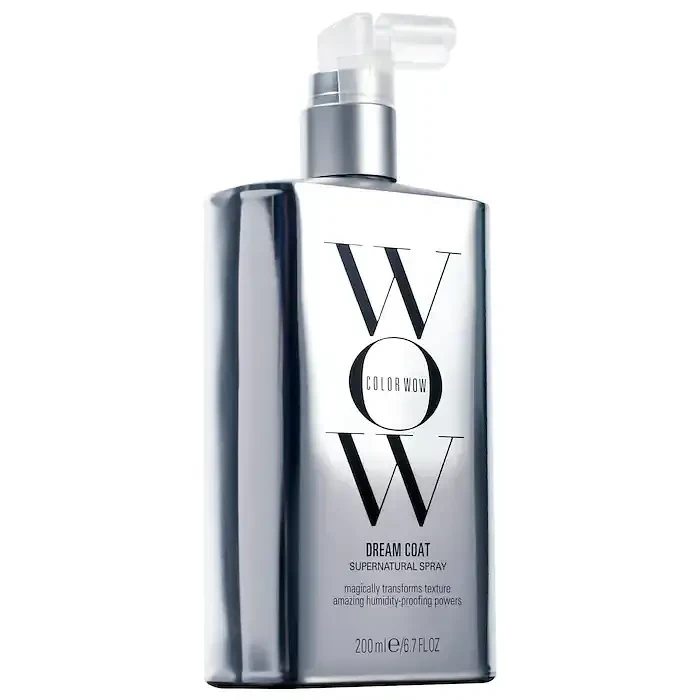
Color Wow Dream Coat Supernatural Spray by Color Wow
Color Wow

Color Wow Dream Coat Supernatural Spray

Styling Creams & Sprayshair care

Safety score

Pregnancy-focused assessment

Low Risk76/100
Higher concernLower concern

One or more ingredients have a low-risk flag in MamaSkin's current assessment. Review the notes and your own circumstances.

Formula and assessment check

Ingredient safety review updated 24 November 2025. Product formulas can change, so compare the ingredients shown here with the packaging you have.

Report a formula mismatch

MamaSkin assessment · 24 November 2025

Is Color Wow Dream Coat Supernatural Spray suitable during pregnancy?

MamaSkin currently classifies Color Wow Dream Coat Supernatural Spray as Low risk, with a stored score of 76/100. This is a precautionary classification, not an unqualified pregnancy-safe recommendation. Read the ingredient context and any manual-review explanation below.

What does the ingredient evidence show?

The recorded formula includes 1 ingredient entry with a risk flag: Phenoxyethanol (Low risk). These are ingredient-level flags; they do not replace the stored product assessment or account for every formulation detail.

16 of 16 ingredient entries on this page have a recorded score, evidence summary and source text. That describes documentation coverage, not proof that the finished formula has been clinically tested during pregnancy.

Ingredient breakdown

See how the listed formula falls across MamaSkin's pregnancy-focused risk bands.

15

No known risks

1

Low risk

0

Medium risk

0

High risk

Ingredients

Ingredients with a higher risk flag appear first, followed by the rest of the formula.

Phenoxyethanol

Low Risk

Phenoxyethanol is a preservative permitted in EU cosmetics up to 1.0%. The SCCS concluded it is safe for cosmetic use at that level, including when considering higher cosmetic exposure scenarios in infants and young children. Main practical concern is irritation/stinging on very sensitive or compromised skin rather than a pregnancy- or breastfeeding-specific risk.

Sources: SCCS/1575/16: Phenoxyethanol opinion https://health.ec.europa.eu/publications/phenoxyethanol_en

Water

No Known Risks

Water (Aqua) is the standard purified water used as a cosmetic solvent. It has no pregnancy-specific risk in normal topical use.

Sources: https://pubchem.ncbi.nlm.nih.gov/compound/Water, https://single-market-economy.ec.europa.eu/sectors/cosmetics/cosmetic-ingredient-database/cosing-glossary-ingredients_en

Dipropylene Glycol

No Known Risks

Dipropylene glycol is used as a solvent and carrier in cosmetics; topical exposure is low and it has no known pregnancy or breastfeeding concerns at cosmetic concentrations.

Sources: CIR; EU/UK Cosmetics Regulation

Show all (16)

Polysilicone-29

No Known Risks

For ordinary, correctly formulated topical cosmetic use, no pregnancy-specific harm has been identified for polysilicone-29. Film-forming silicone polymer; little systemic exposure expected in ordinary intact-skin use. Exact assessment not established. Direct pregnancy studies of this exact material are limited; this assessment does not cover ingestion, medicinal-strength use, damaged skin, or aerosol exposure.

Sources: https://www.cir-safety.org/sites/default/files/Methicones_4.pdf

Silicone Quaternium-18

No Known Risks

silicone quaternium-18 is a cosmetic polymer, silicone derivative or film-forming formulation aid. Systemic dermal absorption is expected to be limited for the finished high-molecular-weight material, subject to residual-monomer and impurity controls. No pregnancy-specific concern was identified for normal topical use.

Sources: CIR silicone, vinyl-polymer and cosmetic-copolymer safety assessments; CIR Quick Reference Table https://www.cir-safety.org/supplementaldoc/quick-reference-table-december-2025.

Glycerin

No Known Risks

Glycerin is a widely used humectant that supports hydration and the skin barrier, with a long safety record and no known pregnancy or breastfeeding concerns in topical cosmetic use.

Sources: CIR; EU/UK Cosmetics Regulation

Trideceth-6

No Known Risks

An ethoxylated fatty alcohol used mainly as an emulsifier, surfactant or solubiliser. Cosmetic safety reviewers concluded that alkyl PEG/PPG ethers are safe in current practices when formulated to be non-irritating. Manufacturing controls should limit residual ethylene oxide and 1,4-dioxane.

Sources: CIR: Safety Assessment of Alkyl PEG/PPG Ethers as Used in Cosmetics https://cir-safety.org/supplementaldoc/safety-assessment-alkyl-peg/ppg-ethers-used-cosmetics

Chamomilla Recutita Flower Extract

No Known Risks

A German chamomile flower extract used for skin conditioning and soothing. Cosmetic safety reviewers concluded that Chamomilla recutita flower-derived ingredients are safe in current cosmetic use when formulated to be non-sensitizing. Chamomile can cause contact allergy in susceptible people, particularly those sensitive to plants in the Asteraceae family, but no pregnancy-specific concern is identified for normal topical cosmetic exposure.

Sources: CIR: Safety Assessment of Chamomilla Recutita-Derived Ingredients as Used in Cosmetics https://cir-safety.org/supplementaldoc/safety-assessment-chamomilla-recutita-derived-ingredients-used-cosmetics-0

Calendula Officinalis Flower Extract

No Known Risks

A flower extract used for skin conditioning and soothing. Cosmetic safety reviewers concluded that Calendula officinalis-derived ingredients, including the flower extract, are safe in current cosmetic practices of use and concentration. Available testing did not identify significant systemic, reproductive or developmental toxicity at cosmetic exposure, although botanical sensitivity remains possible. No pregnancy-specific topical contraindication was identified.

Sources: CIR: Amended Safety Assessment of Calendula officinalis-Derived Cosmetic Ingredients https://cir-reports.cir-safety.org/view-attachment/?id=a9ee6359-8e74-ec11-8943-0022482f06a6

Potassium Sorbate

No Known Risks

Preservative widely used in foods and cosmetics. Considered safe at regulated concentrations with low systemic exposure from topical use.

Sources: Scientific Committee on Consumer Safety (EU); European cosmetics regulatory framework

Trideceth-12

No Known Risks

An ethoxylated fatty alcohol used mainly as an emulsifier, surfactant or solubiliser. Cosmetic safety reviewers concluded that alkyl PEG/PPG ethers are safe in current practices when formulated to be non-irritating. Manufacturing controls should limit residual ethylene oxide and 1,4-dioxane.

Sources: CIR: Safety Assessment of Alkyl PEG/PPG Ethers as Used in Cosmetics https://cir-safety.org/supplementaldoc/safety-assessment-alkyl-peg/ppg-ethers-used-cosmetics

Sodium Benzoate

No Known Risks

Preservative widely used in foods and cosmetics. Considered safe at regulated concentrations with low systemic exposure from topical use.

Sources: Scientific Committee on Consumer Safety (EU); European cosmetics regulatory framework

Chlorphenesin

No Known Risks

Preservative used to help protect formulas from microbial growth. Reviewed cosmetic safety sources support present cosmetic use; no pregnancy- or breastfeeding-specific topical concern was identified in the material reviewed, although some users may still notice local irritation or sensitivity.

Sources: CIR: Safety Assessment of Chlorphenesin as Used in Cosmetics; EU CosIng / cosmetics regulatory inventory

Potassium Benzoate

No Known Risks

A functional cosmetic ingredient used for preservation support, pH control, chelation, solvent action or formula stability. Concentrated material may irritate skin or eyes, but no pregnancy-specific reproductive or developmental hazard was identified for normal use in a compliant finished cosmetic.

Sources: European Commission CosIng ingredient inventory and applicable cosmetic restrictions; relevant CIR ingredient and functional-family safety assessments.

Disodium EDTA

No Known Risks

Disodium EDTA is a chelating agent used to improve formula stability and performance; it is considered low concern in topical cosmetic use, with no known pregnancy or breastfeeding risks at typical concentrations.

Sources: CIR; EU/UK Cosmetics Regulation

Citric Acid

No Known Risks

pH adjuster used in small amounts to maintain product stability. Not associated with pregnancy-specific concerns.

Sources: Scientific Committee on Consumer Safety (EU); European cosmetics regulatory framework

Formulations can change without notice. For the most accurate result, compare this list with your packaging and scan the exact ingredient label in MamaSkin when you repurchase.

Questions about this assessment

Has every ingredient in Color Wow Dream Coat Supernatural Spray been assessed?

16 of 16 ingredient entries on this page have a recorded score, evidence summary and source text. That describes documentation coverage, not proof that the finished formula has been clinically tested during pregnancy.

Does this assessment apply to the Color Wow Dream Coat Supernatural Spray I have?

Only if the ingredient list on your packaging matches the recorded formula shown here. Formulas can differ by market and change over time. Compare the full list, not just the product name; report a mismatch if it differs.

Does this pregnancy assessment also establish breastfeeding suitability?

No. This page presents a pregnancy-focused product assessment. Do not infer a breastfeeding conclusion from its score or label; breastfeeding requires a separate assessment of the formula and how it is used.

How to use this assessment

The risk band is the primary conclusion. The score adds detail within that band and should not be used to compare products as if a one-point difference were clinically meaningful.

MamaSkin provides pregnancy-focused information, not medical advice. Your midwife, GP, pharmacist or dermatologist should take priority when your circumstances differ from typical cosmetic use.

Read the full methodology