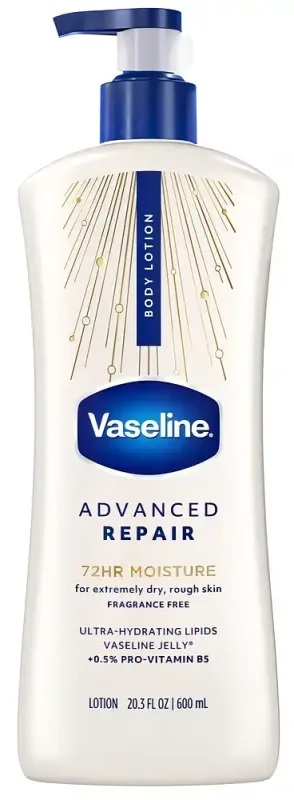
Vaseline Advanced Repair 72Hr Moisture Lotion by Vaseline
Vaseline

Vaseline Advanced Repair 72Hr Moisture Lotion

Body Lotions

Safety score

Pregnancy-focused assessment

Medium Risk53/100
Higher concernLower concern

This formula contains an ingredient that needs extra caution in MamaSkin's pregnancy-focused assessment.

Formula and assessment check

Ingredient safety review updated 7 January 2026. Product formulas can change, so compare the ingredients shown here with the packaging you have.

Report a formula mismatch

Ingredient breakdown

See how the listed formula falls across MamaSkin's pregnancy-focused risk bands.

15

No known risks

3

Low risk

2

Medium risk

0

High risk

Ingredients

Ingredients with a higher risk flag appear first, followed by the rest of the formula.

Methylparaben

Medium Risk

Methylparaben is a preservative in the paraben family. Toxicology datasets generally show low acute toxicity; concerns focus on weak endocrine activity observed in some assays, plus aggregate exposure and limited pregnancy-specific outcome data for topical cosmetic use. The medium-risk signal is endocrine-related uncertainty and conservative pregnancy-focused avoidance rather than a clearly demonstrated pregnancy harm at cosmetic exposure levels.

Sources: EU SCCS Opinion on Methylparaben (SCCS/1653/23; sccs_o_276_final.pdf, 2023); CIR: Amended Safety Assessment of Parabens as used in cosmetics (2019).

Propylparaben

Medium Risk

Propylparaben is a preservative in the paraben family. The main concern is endocrine activity signals (oestrogenic activity in some assays) and conservative risk management around aggregate exposure; pregnancy-specific outcome data for topical cosmetic exposure are limited. The medium-risk signal is endocrine-related uncertainty and limited pregnancy-specific evidence rather than a confirmed pregnancy-specific toxicity endpoint.

Sources: EU SCCS Opinion on Propylparaben (SCCS/1623/20; sccs_o_243.pdf, 2021) and related SCCS parabens opinions; CIR: Amended Safety Assessment of Parabens (2019).

Phenoxyethanol

Low Risk

Phenoxyethanol is a preservative permitted in EU cosmetics up to 1.0%. The SCCS concluded it is safe for cosmetic use at that level, including when considering higher cosmetic exposure scenarios in infants and young children. Main practical concern is irritation/stinging on very sensitive or compromised skin rather than a pregnancy- or breastfeeding-specific risk.

Sources: EU SCCS; EU Cosmetics Regulation (Annex V preservative limit), SCCS Opinion on Phenoxyethanol (SCCS/1575/16, 2016)

Show all (20)

Triethanolamine

Low Risk

Triethanolamine (TEA) is an alkanolamine used as a pH adjuster and surfactant in cosmetics. The main practical concerns are skin/eye irritation at higher concentrations and the potential formation of nitrosamines if formulated with nitrosating agents (a formulation/impurity-control issue). It is not a typical pregnancy-specific concern at cosmetic use levels; overall risk is primarily local irritation/sensitisation in susceptible users.

Sources: CIR: Safety Assessment of Triethanolamine (TEA) and TEA-containing ingredients as used in cosmetics (Fiume et al., 2013); CIR Resource Document: N-Nitrosation and cosmetic ingredient safety; EU CosIng (Triethanolamine).

Dimethicone

Low Risk

Dimethicone is a silicone polymer used as a skin protectant and slip/conditioning agent. It is considered inert with minimal dermal absorption; the main practical issues are cosmetic (feel) and occasional irritation in very sensitive users. It is not a pregnancy-specific concern in topical cosmetic use.

Sources: CIR: Safety Assessment of Dimethicone, Methicone, and related ingredients as used in cosmetics (Methicones report; 2019/2022 update); EU CosIng entry for Dimethicone.

Acrylates/C10-30 Alkyl Acrylate Crosspolymer

No Known Risks

Polymer thickener and stabiliser used in creams and sunscreens. Low systemic exposure expected.

Sources: Cosmetic Ingredient Review (US); Scientific Committee on Consumer Safety (EU)

Cetyl Alcohol

No Known Risks

Fatty alcohol used to improve texture and skin feel. Considered safe for cosmetic use without pregnancy-specific concerns.

Sources: Cosmetic Ingredient Review (US); Scientific Committee on Consumer Safety (EU)

Disodium Edta

No Known Risks

Disodium EDTA is a chelating agent used to improve formula stability and performance; it is considered low concern in topical cosmetic use, with no known pregnancy or breastfeeding risks at typical concentrations.

Sources: CIR; EU/UK Cosmetics Regulation

Glycerin

No Known Risks

Glycerin is a widely used humectant that supports hydration and the skin barrier, with a long safety record and no known pregnancy or breastfeeding concerns in topical cosmetic use.

Sources: CIR; EU/UK Cosmetics Regulation

Glyceryl Stearate

No Known Risks

Emulsifier and emollient used to stabilise creams and lotions. Not associated with pregnancy-specific concerns at cosmetic exposure.

Sources: Cosmetic Ingredient Review (US); Scientific Committee on Consumer Safety (EU)

Glycol Stearate

No Known Risks

A fatty-acid ester used mainly for emollience, slip, cleansing or formula texture. Cosmetic safety reviewers concluded that these named esters are safe in current cosmetic practices, with non-irritating formulation conditions where specified.

Sources: CIR: Glycol Stearate, Ethylhexyl Olivate, Cetearyl Isononanoate, Heptyl Undecylenate, Isostearyl Neopentanoate and Octyldodecyl Myristate conclusions; December 2025 Quick Reference Table https://cir-safety.org/sites/default/files/QRT-Update-Dec2025.pdf

Helianthus Annuus Seed Oil

No Known Risks

Helianthus annuus (sunflower) seed oil is a common emollient rich in fatty acids and is generally well tolerated, with no known pregnancy or breastfeeding concerns in topical cosmetic use.

Sources: CIR; EU/UK Cosmetics Regulation

Isopropyl Palmitate

No Known Risks

This emollient ester improves slip and skin feel. Cosmetic Ingredient Review assessments support use in current cosmetic concentrations when formulated to be non-irritating; topical use is not identified as a pregnancy- or breastfeeding-specific concern. Some alkyl esters can increase penetration of other formula ingredients.

Sources: CIR: Safety Assessment of Alkyl Esters as Used in Cosmetics https://cir-safety.org/supplementaldoc/safety-assessment-alkyl-esters-used-cosmetics

Panthenol

No Known Risks

Panthenol (pro-vitamin B5) is used for soothing and barrier support and is generally well tolerated, with no known pregnancy or breastfeeding concerns in topical cosmetic use.

Sources: CIR; EU/UK Cosmetics Regulation

Paraffinum Liquidum

No Known Risks

Highly refined mineral oil (occlusive emollient). Cosmetic-grade mineral oil has very low skin absorption and is widely considered safe for topical use during pregnancy when used as intended. Concerns raised online typically relate to unrefined/poorly refined mineral oils and dietary mineral oil hydrocarbons, not regulated cosmetic-grade topical use.

Sources: BfR (Federal Institute for Risk Assessment), Highly refined mineral oils in cosmetics: Health risks are not to be expected according to current knowledge (2018). ; Petry et al., Review of data on the dermal penetration of mineral oils and waxes used in cosmetic products (Food and Chemical Toxicology, 2017). ; EFSA, Scientific Opinion on Mineral Oil Hydrocarbons in Food (2012).

Peg-100 Stearate

No Known Risks

Emulsifier used to stabilize creams and lotions. Reviewed cosmetic safety sources support use of PEG stearates in cosmetics, with no pregnancy- or breastfeeding-specific concern identified for normal topical use.

Sources: CIR: Safety Assessment of PEG Stearates as Used in Cosmetics; EU CosIng / cosmetics regulatory inventory

Petrolatum

No Known Risks

Highly refined petrolatum (petroleum jelly) is a skin protectant/occlusive with minimal dermal penetration; safety depends on refining/PAH impurity controls and cosmetic/medical grades meet established standards.

Sources: USP White Petrolatum monograph (2021); Petry et al., Food and Chemical Toxicology (2017); PubMed (dermatology review)

Stearamide Amp

No Known Risks

Stearic Acid

No Known Risks

Stearic acid is a fatty acid used to stabilise emulsions and improve texture; it is considered low concern in topical cosmetics with no known pregnancy or breastfeeding risks at typical concentrations.

Sources: CIR; EU/UK Cosmetics Regulation

Water

No Known Risks

Formulations can change without notice. For the most accurate result, compare this list with your packaging and scan the exact ingredient label in MamaSkin when you repurchase.

How to use this assessment

The risk band is the primary conclusion. The score adds detail within that band and should not be used to compare products as if a one-point difference were clinically meaningful.

MamaSkin provides pregnancy-focused information, not medical advice. Your midwife, GP, pharmacist or dermatologist should take priority when your circumstances differ from typical cosmetic use.

Read the full methodology