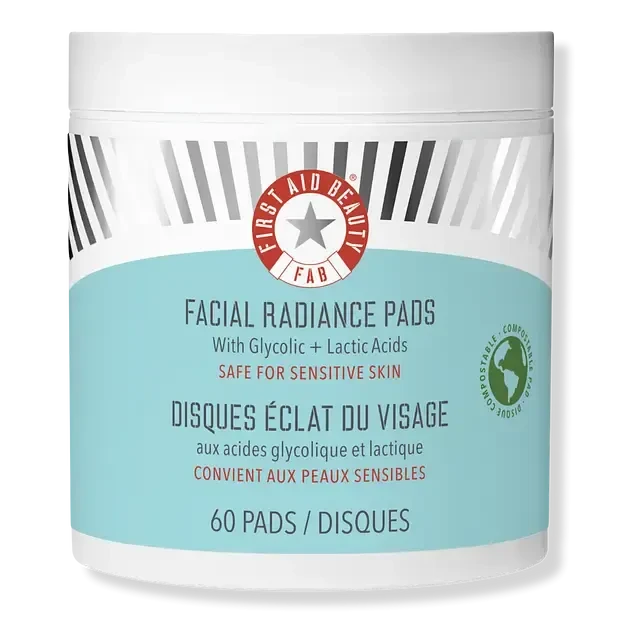
First Aid Beauty Facial Radiance Pads With Glycolic + Lactic Acids by First Aid Beauty
First Aid Beauty

First Aid Beauty Facial Radiance Pads With Glycolic + Lactic Acids

Exfoliators

Safety score

Pregnancy-focused assessment

Low Risk72/100
Higher concernLower concern

One or more ingredients have a low-risk flag in MamaSkin's current assessment. Review the notes and your own circumstances.

Formula and assessment check

Ingredient safety review updated 22 January 2026. Product formulas can change, so compare the ingredients shown here with the packaging you have.

Report a formula mismatch

MamaSkin assessment · 22 January 2026

Is First Aid Beauty Facial Radiance Pads With Glycolic + Lactic Acids suitable during pregnancy?

MamaSkin currently classifies First Aid Beauty Facial Radiance Pads With Glycolic + Lactic Acids as Low risk, with a stored score of 72/100. This is a precautionary classification, not an unqualified pregnancy-safe recommendation. Read the ingredient context and any manual-review explanation below.

What does the ingredient evidence show?

The recorded formula includes 5 ingredient entries with risk flags: Lactic Acid (Low risk), Glycolic Acid (Low risk), Chrysanthemum Parthenium Extract (Low risk), plus others listed in the breakdown. These are ingredient-level flags; they do not replace the stored product assessment or account for every formulation detail.

20 of 20 ingredient entries on this page have a recorded score, evidence summary and source text. That describes documentation coverage, not proof that the finished formula has been clinically tested during pregnancy.

Ingredient breakdown

See how the listed formula falls across MamaSkin's pregnancy-focused risk bands.

15

No known risks

5

Low risk

0

Medium risk

0

High risk

Ingredients

Ingredients with a higher risk flag appear first, followed by the rest of the formula.

Phenoxyethanol

Low Risk

Phenoxyethanol is a preservative permitted in EU cosmetics up to 1.0%. The SCCS concluded it is safe for cosmetic use at that level, including when considering higher cosmetic exposure scenarios in infants and young children. Main practical concern is irritation/stinging on very sensitive or compromised skin rather than a pregnancy- or breastfeeding-specific risk.

Sources: SCCS/1575/16: Phenoxyethanol opinion https://health.ec.europa.eu/publications/phenoxyethanol_en
Lactic Acid

Low Risk

Endogenous alpha-hydroxy acid and humectant; at modest cosmetic concentrations (≈5% and below, and generally <10%) topical lactic acid is considered compatible with pregnancy. Main risks are local irritation and increased photosensitivity rather than systemic toxicity or fetal effects.

Sources: MotherToBaby: Topical acne treatments in pregnancy and breastfeeding https://www.ncbi.nlm.nih.gov/books/NBK582985/

Glycolic Acid

Low Risk

Alpha-hydroxy acid exfoliant. Listed by MotherToBaby as a common OTC topical acne ingredient used during pregnancy; when used as directed, OTC topical acne treatments are not expected to increase pregnancy complications. For consumer cosmetics, safety guidance commonly frames AHAs as safe at ≤10% (with appropriate pH and daily sun protection). Avoid high-strength/professional peels during pregnancy.

Sources: MotherToBaby: Topical acne treatments in pregnancy and breastfeeding https://www.ncbi.nlm.nih.gov/books/NBK582985/

Show all (20)

Chrysanthemum Parthenium Extract

Low Risk

Feverfew (Tanacetum/Chrysanthemum parthenium) has uterine-stimulant medicinal signals and a pregnancy ingestion warning; its parthenolide concentration and dermal systemic dose in this cosmetic extract are unknown. Low rather than Medium reflects that route gap.

Sources: https://www.ema.europa.eu/en/documents/herbal-report/final-assessment-report-tanacetum-parthenium-l-schulz-bip-herba-revision-1_en.pdf, https://www.nccih.nih.gov/health/feverfew

Glycyrrhiza Glabra Root Extract

Low Risk

Pregnancy concerns around licorice are based mainly on high oral glycyrrhizin intake, which has been linked to shorter gestation and cortisol-related effects in offspring; by contrast, licorice root extracts have been assessed as safe as used in cosmetics, so routine topical skincare exposure fits a cautious low-risk classification.

Sources: CIR: Cosmetic safety assessment covering Glycyrrhiza glabra-derived ingredients https://cir-reports.cir-safety.org/view-attachment/?id=49a63435-8e74-ec11-8943-0022482f06a6

Water

No Known Risks

Water (Aqua) is the standard purified water used as a cosmetic solvent. It has no pregnancy-specific risk in normal topical use.

Sources: https://pubchem.ncbi.nlm.nih.gov/compound/Water, https://single-market-economy.ec.europa.eu/sectors/cosmetics/cosmetic-ingredient-database/cosing-glossary-ingredients_en

Aloe Barbadensis Leaf Juice

No Known Risks

Aloe barbadensis leaf juice is commonly used for soothing and hydration; topical use is considered low concern with no known pregnancy or breastfeeding risks, although rare sensitivities can occur.

Sources: CIR; EU/UK Cosmetics Regulation

Glycerin

No Known Risks

Glycerin is a widely used humectant that supports hydration and the skin barrier, with a long safety record and no known pregnancy or breastfeeding concerns in topical cosmetic use.

Sources: CIR; EU/UK Cosmetics Regulation

Cucumis Sativus Fruit Extract

No Known Risks

A cucumber fruit extract used for skin conditioning. Cosmetic safety reviewers concluded that Cucumis sativus-derived ingredients are safe in current cosmetic practices of use and concentration when formulated to avoid sensitisation. No pregnancy-specific concern was identified for normal topical cosmetic exposure, although irritation or allergy to a botanical-containing formula remains possible.

Sources: CIR: Final Safety Assessment of Cucumis sativus (Cucumber)-Derived Ingredients https://cir-safety.org/supplementaldoc/final-safety-assessment-cucumis-sativus-cucumber-derived-ingredients

Leuconostoc/Radish Root Ferment Filtrate

No Known Risks

A filtered radish-root fermentation product used mainly for skin conditioning and formulation support. Cosmetic safety reviewers concluded that the reviewed radish-root-derived ingredients, including Leuconostoc/Radish Root Ferment Filtrate, are safe in current cosmetic use when formulated to be non-irritating. Testing at cosmetic-relevant concentrations did not identify irritation, sensitization, phototoxicity or ocular irritation concerns.

Sources: CIR: Safety Assessment of Radish Root-Derived Ingredients https://cir-safety.org/sites/default/files/FR_RadishRoot_062022.pdf

Sodium Hydroxide

No Known Risks

pH adjuster used in very small quantities to balance formulations. Not associated with pregnancy-specific concerns.

Sources: Scientific Committee on Consumer Safety (EU); European cosmetics regulatory framework

Polysorbate 20

No Known Risks

Nonionic surfactant and solubiliser used to disperse oils and fragrance. Reviewed cosmetic safety sources support normal topical use, with no pregnancy- or breastfeeding-specific topical signal identified in the material reviewed.

Sources: CIR: Safety Assessment of Polysorbates as Used in Cosmetics; EU CosIng / cosmetics regulatory inventory

Camellia Sinensis Leaf Extract

No Known Risks

Camellia sinensis (green tea) leaf extract is used as an antioxidant botanical; topical cosmetic use is considered low concern with no known pregnancy or breastfeeding risks, though rare sensitivities are possible.

Sources: CIR; EU/UK Cosmetics Regulation

Citrus Nobilis Fruit Extract

No Known Risks

CIR assesses Citrus nobilis (mandarin orange) fruit extract as safe in current cosmetic use when non-irritating and non-sensitizing and with no more than 15 ppm 5-methoxypsoralen in leave-on products. This exact fruit preparation is not peel oil. No pregnancy-specific hazard was identified for normal topical use; direct pregnancy studies are limited.

Sources: https://cir-safety.org/sites/default/files/QRT-Update-Dec2025.pdf

Citrus Limon Peel Extract

No Known Risks

A non-oil citrus extract used mainly for skin conditioning and antioxidant support. It is distinct from concentrated peel oil. No pregnancy-specific hazard was identified for normal topical cosmetic exposure; local allergy or irritation remains possible.

Sources: CIR safety assessments of Citrus Fruit-, Peel-, Flower-, Leaf-, Plant- and Seed-Derived Ingredients; European Commission CosIng ingredient inventory.

Hyaluronic Acid

No Known Risks

High-water-binding humectant used to support hydration at the skin surface. Reviewed cosmetic safety sources support normal topical use, with no pregnancy- or breastfeeding-specific topical signal identified in the material reviewed.

Sources: CIR: Safety Assessment of Hyaluronates as Used in Cosmetics; EU CosIng / cosmetics regulatory inventory

Phyllanthus Emblica Fruit Extract

No Known Risks

A botanical extract, juice or water used primarily for skin conditioning, moisturising, soothing or antioxidant support. Direct pregnancy studies of the named cosmetic material were not identified. No reproductive or developmental hazard was identified for normal topical exposure to a compliant finished cosmetic; oral herbal or medicinal use is outside this classification.

Sources: European Commission CosIng ingredient inventory; Cosmetic Ingredient Review botanical safety-assessment framework and relevant plant-family assessments. No ingredient-specific human pregnancy study of normal topical cosmetic use was identified.

EDTA

No Known Risks

Chelating agent (often listed as EDTA); minimal dermal absorption and no known pregnancy or breastfeeding risks at typical cosmetic concentrations.

Sources: CIR; EU/UK Cosmetics Regulation

Tetrasodium EDTA

No Known Risks

Chelating agent used to stabilise formulations; minimal dermal absorption and no known pregnancy or breastfeeding risks at typical cosmetic concentrations.

Sources: CIR; EU/UK Cosmetics Regulation

Chlorphenesin

No Known Risks

Preservative used to help protect formulas from microbial growth. Reviewed cosmetic safety sources support present cosmetic use; no pregnancy- or breastfeeding-specific topical concern was identified in the material reviewed, although some users may still notice local irritation or sensitivity.

Sources: CIR: Safety Assessment of Chlorphenesin as Used in Cosmetics; EU CosIng / cosmetics regulatory inventory

Formulations can change without notice. For the most accurate result, compare this list with your packaging and scan the exact ingredient label in MamaSkin when you repurchase.

Questions about this assessment

Has every ingredient in First Aid Beauty Facial Radiance Pads With Glycolic + Lactic Acids been assessed?

20 of 20 ingredient entries on this page have a recorded score, evidence summary and source text. That describes documentation coverage, not proof that the finished formula has been clinically tested during pregnancy.

Does this assessment apply to the First Aid Beauty Facial Radiance Pads With Glycolic + Lactic Acids I have?

Only if the ingredient list on your packaging matches the recorded formula shown here. Formulas can differ by market and change over time. Compare the full list, not just the product name; report a mismatch if it differs.

Does this pregnancy assessment also establish breastfeeding suitability?

No. This page presents a pregnancy-focused product assessment. Do not infer a breastfeeding conclusion from its score or label; breastfeeding requires a separate assessment of the formula and how it is used.

How to use this assessment

The risk band is the primary conclusion. The score adds detail within that band and should not be used to compare products as if a one-point difference were clinically meaningful.

MamaSkin provides pregnancy-focused information, not medical advice. Your midwife, GP, pharmacist or dermatologist should take priority when your circumstances differ from typical cosmetic use.

Read the full methodology