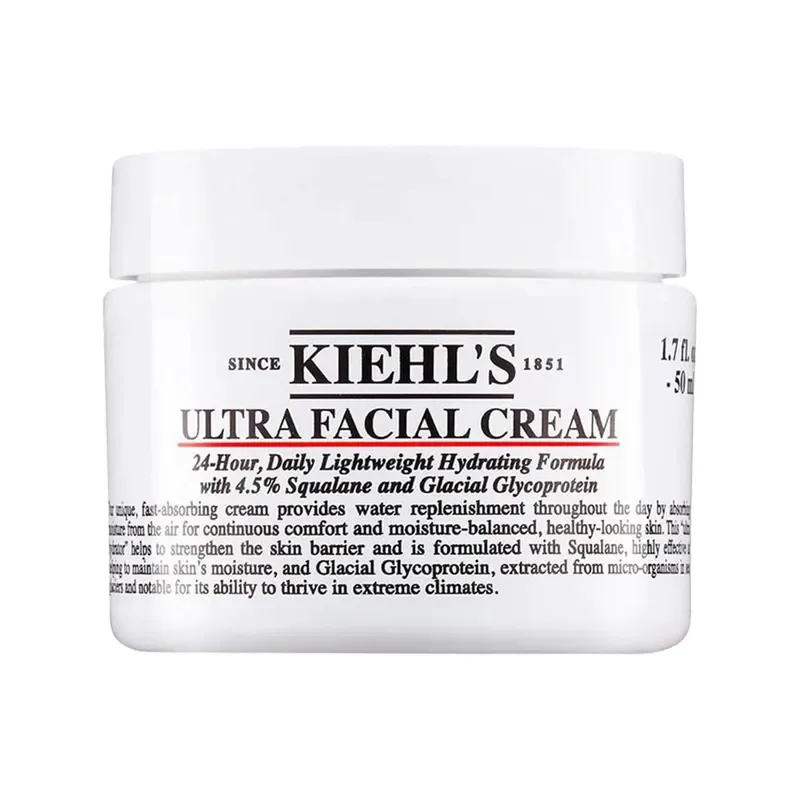
Kiehl's Ultra Facial Moisturizing Cream with Squalane by Kiehl's
Kiehl's

Kiehl's Ultra Facial Moisturizing Cream with Squalane

General MoisturizersSkin Care

Safety score

Pregnancy-focused assessment

Low Risk74/100
Higher concernLower concern

One or more ingredients have a low-risk flag in MamaSkin's current assessment. Review the notes and your own circumstances.

Formula and assessment check

Ingredient safety review updated 19 May 2026. Product formulas can change, so compare the ingredients shown here with the packaging you have.

Report a formula mismatch

Ingredient breakdown

See how the listed formula falls across MamaSkin's pregnancy-focused risk bands.

32

No known risks

3

Low risk

0

Medium risk

0

High risk

Ingredients

Ingredients with a higher risk flag appear first, followed by the rest of the formula.

Phenoxyethanol

Low Risk

Phenoxyethanol is a preservative permitted in EU cosmetics up to 1.0%. The SCCS concluded it is safe for cosmetic use at that level, including when considering higher cosmetic exposure scenarios in infants and young children. Main practical concern is irritation/stinging on very sensitive or compromised skin rather than a pregnancy- or breastfeeding-specific risk.

Sources: EU SCCS; EU Cosmetics Regulation (Annex V preservative limit), SCCS Opinion on Phenoxyethanol (SCCS/1575/16, 2016)

Dimethicone

Low Risk

Dimethicone is a silicone polymer used as a skin protectant and slip/conditioning agent. It is considered inert with minimal dermal absorption; the main practical issues are cosmetic (feel) and occasional irritation in very sensitive users. It is not a pregnancy-specific concern in topical cosmetic use.

Sources: CIR: Safety Assessment of Dimethicone, Methicone, and related ingredients as used in cosmetics (Methicones report; 2019/2022 update); EU CosIng entry for Dimethicone.

Salicylic Acid

Low Risk

Salicylic acid is a beta hydroxy acid used for exfoliation. Low-strength topical use (up to 2%) on limited areas is generally considered low risk. Higher concentrations, large-area use, or professional peels are avoided during pregnancy due to systemic absorption concerns.

Sources: PubMed, U.S. National Library of Medicine (NLM), NHS, MotherToBaby (OTIS), UKTIS (BUMPS)

Show all (35)

Aqua / Water

No Known Risks

Glycerin

No Known Risks

Glycerin is a widely used humectant that supports hydration and the skin barrier, with a long safety record and no known pregnancy or breastfeeding concerns in topical cosmetic use.

Sources: CIR; EU/UK Cosmetics Regulation

Squalane

No Known Risks

Lightweight emollient used to support the skin barrier. Not associated with pregnancy-specific concerns at cosmetic exposure levels.

Sources: Cosmetic Ingredient Review (US); Scientific Committee on Consumer Safety (EU)

Bis-Peg-18 Methyl Ether Dimethyl Silane

No Known Risks

An ethoxylated silicone used as a humectant, emulsifier and skin-conditioning ingredient. Cosmetic safety assessments of PEG-modified silicones support current topical uses, with low expected absorption of the intact material and control of manufacturing impurities.

Sources: CIR: Safety Assessment of PEG/PPG-modified silicones, including methyl ether dimethicones; CIR December 2025 Quick Reference Table https://cir-safety.org/sites/default/files/QRT-Update-Dec2025.pdf

Sucrose Stearate

No Known Risks

A sugar-derived fatty-acid ester used as an emulsifier and emollient. Cosmetic safety reviewers concluded that the assessed sucrose fatty acid esters, including sucrose stearate, are safe in current practices of use and concentration. No pregnancy-specific concern was identified for normal topical exposure.

Sources: CIR: Safety Assessment of Sucrose Fatty Acid Esters as Used in Cosmetics, IJT 40(Suppl. 2), 2021; December 2025 Quick Reference Table https://cir-safety.org/sites/default/files/QRT-Update-Dec2025.pdf

Stearyl Alcohol

No Known Risks

Fatty alcohol used as an emollient and stabiliser. Not associated with pregnancy-specific concerns at cosmetic exposure.

Sources: Cosmetic Ingredient Review (US); Scientific Committee on Consumer Safety (EU)

Peg-8 Stearate

No Known Risks

Myristyl Myristate

No Known Risks

A fatty-acid ester used mainly for emollience, slip and formula texture. Cosmetic safety reviewers concluded that the assessed alkyl esters are safe in current practices when formulated to be non-irritating. No pregnancy-specific concern was identified for normal topical cosmetic exposure.

Sources: CIR: Safety Assessment of Alkyl Esters as Used in Cosmetics https://cir-reports.cir-safety.org/view-attachment/?id=b34bc38f-8e74-ec11-8943-0022482f06a6

Prunus Armeniaca Kernel Oil / Apricot Kernel Oil

No Known Risks

Persea Gratissima Oil / Avocado Oil

No Known Risks

Glyceryl Stearate

No Known Risks

Emulsifier and emollient used to stabilise creams and lotions. Not associated with pregnancy-specific concerns at cosmetic exposure.

Sources: Cosmetic Ingredient Review (US); Scientific Committee on Consumer Safety (EU)

Cetyl Alcohol

No Known Risks

Fatty alcohol used to improve texture and skin feel. Considered safe for cosmetic use without pregnancy-specific concerns.

Sources: Cosmetic Ingredient Review (US); Scientific Committee on Consumer Safety (EU)

Oryza Sativa Bran Oil / Rice Bran Oil

No Known Risks

Olea Europaea Fruit Oil / Olive Fruit Oil

No Known Risks

Chlorphenesin

No Known Risks

Preservative used to help protect formulas from microbial growth. Reviewed cosmetic safety sources support present cosmetic use; no pregnancy- or breastfeeding-specific topical concern was identified in the material reviewed, although some users may still notice local irritation or sensitivity.

Sources: CIR: Safety Assessment of Chlorphenesin as Used in Cosmetics; EU CosIng / cosmetics regulatory inventory

Stearic Acid

No Known Risks

Stearic acid is a fatty acid used to stabilise emulsions and improve texture; it is considered low concern in topical cosmetics with no known pregnancy or breastfeeding risks at typical concentrations.

Sources: CIR; EU/UK Cosmetics Regulation

Palmitic Acid

No Known Risks

Fatty acid used as an emollient, cleansing-support and texture ingredient. It is not associated with pregnancy- or breastfeeding-specific concerns in normal topical cosmetic use.

Sources: CIR: Safety Assessment of Fatty Acids and Fatty Acid Salts as Used in Cosmetics; EU CosIng / cosmetics regulatory inventory

Carbomer

No Known Risks

Polymer thickener used to create gel textures. Large-molecule ingredient with negligible systemic absorption.

Sources: Cosmetic Ingredient Review (US); Scientific Committee on Consumer Safety (EU)

Acrylates/C10-30 Alkyl Acrylate Crosspolymer

No Known Risks

Polymer thickener and stabiliser used in creams and sunscreens. Low systemic exposure expected.

Sources: Cosmetic Ingredient Review (US); Scientific Committee on Consumer Safety (EU)

Trisodium Ethylenediamine Disuccinate

No Known Risks

Chelating ingredient used to improve formula stability by binding trace metals. Reviewed cosmetic ingredient references do not identify a pregnancy- or breastfeeding-specific concern for normal topical use.

Sources: CIR cosmetic ingredient safety references for chelating agents; EU CosIng / cosmetics regulatory inventory

Prunus Amygdalus Dulcis Oil / Sweet Almond Oil

No Known Risks

Xanthan Gum

No Known Risks

Natural polysaccharide thickener used for stability and texture. Not associated with pregnancy-specific concerns.

Sources: European cosmetics regulatory framework

Ethylhexylglycerin

No Known Risks

Preservative booster and skin-conditioning agent. Considered safe for cosmetic use with low systemic exposure when used as intended.

Sources: Scientific Committee on Consumer Safety (EU); Cosmetic Ingredient Review (US)

Sodium Hydroxide

No Known Risks

pH adjuster used in very small quantities to balance formulations. Not associated with pregnancy-specific concerns.

Sources: Scientific Committee on Consumer Safety (EU); European cosmetics regulatory framework

Tocopherol

No Known Risks

Vitamin E antioxidant used to protect oils and support the skin barrier. Not associated with pregnancy-specific concerns at cosmetic exposure.

Sources: Cosmetic Ingredient Review (US); Scientific Committee on Consumer Safety (EU)

Glycine Soja Oil / Soybean Oil

No Known Risks

Pseudoalteromonas Ferment Extract

No Known Risks

A processed cosmetic ferment, extract or fermentation-derived material used for conditioning, moisturising or formula support. It is not equivalent to applying an unspecified live culture. Available cosmetic safety assessments do not identify a pregnancy- or breastfeeding-specific hazard for normal topical use, assuming appropriate identity, preservation and microbial-quality controls.

Sources: CIR safety assessments and strategy documents for Yeast-Derived Ingredients, Lactobacillus Ferment Ingredients and cosmetic microbial fermentation products; European Commission CosIng ingredient inventory.

Myristic Acid

No Known Risks

This naturally occurring fatty acid is used for emolliency, cleansing support or texture. The Cosmetic Ingredient Review concluded that assessed fatty acids are safe in current cosmetic use when formulated to be non-irritating and non-sensitizing; some can increase penetration of other formula ingredients.

Sources: CIR: Safety Assessment of Fatty Acids and Fatty Acid Salts as Used in Cosmetics https://cir-safety.org/supplementaldoc/safety-assessment-fatty-acids-fatty-acid-salts-used-cosmetic

Hydroxypalmitoyl Sphinganine

No Known Risks

Helianthus Annuus Seed Oil / Sunflower Seed Oil

No Known Risks

Rosmarinus Officinalis Leaf Extract / Rosemary Leaf Extract

No Known Risks

Citric Acid.

No Known Risks

Formulations can change without notice. For the most accurate result, compare this list with your packaging and scan the exact ingredient label in MamaSkin when you repurchase.

How to use this assessment

The risk band is the primary conclusion. The score adds detail within that band and should not be used to compare products as if a one-point difference were clinically meaningful.

MamaSkin provides pregnancy-focused information, not medical advice. Your midwife, GP, pharmacist or dermatologist should take priority when your circumstances differ from typical cosmetic use.

Read the full methodology