Nivea
Nivea Crème
Low risk76/100

Deodorant
Some ingredients carry a low-risk flag. Read the formulation context before deciding.
16 of 17 ingredients rated1 not assessed
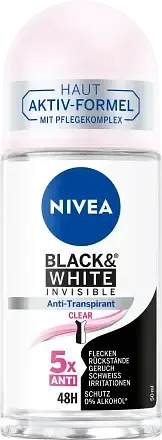
MamaSkin rates the recorded formula for Nivea Antiperspirant Deodorant Roll-On Black & White Invisible Clear as Low risk (76/100). Review the ingredient context and any manual-review explanation before deciding.
The recorded formula includes 1 ingredient entry with a risk flag: Parfum (Low risk). These are ingredient-level flags; they do not replace the stored product assessment or account for every formulation detail.
16 of 17 ingredient entries on this page have a recorded score, evidence summary and source text. 1 entry does not have all of those fields. Unmatched or unrated entries are marked Not assessed in grey; missing evidence does not establish safety.
How we assess productsThe recorded formula, with evidence behind each rating. Unmatched ingredients are marked Not assessed in grey.
Umbrella term for an undisclosed fragrance blend. It’s not usually a pregnancy-specific concern at normal cosmetic use levels, but the exact components and concentrations aren’t fully disclosed on the label, so we score it more conservatively. If you prefer maximum transparency (or you’re sensitive to fragrance compounds), choose fragrance-free/unscented products.
Sources: SCCS: Fragrance allergens in cosmetic products https://health.ec.europa.eu/latest-updates/sccs-new-opinion-fragrance-allergens-cosmetic-products-2012-07-31_en
No matched ingredient rating is available yet. Not assessed does not mean safe or unsafe.
Water (Aqua) is the standard purified water used as a cosmetic solvent. It has no pregnancy-specific risk in normal topical use.
Sources: https://pubchem.ncbi.nlm.nih.gov/compound/Water, https://single-market-economy.ec.europa.eu/sectors/cosmetics/cosmetic-ingredient-database/cosing-glossary-ingredients_en
aluminum chlorohydrate is an aluminium antiperspirant ingredient. SCCS concluded that aluminium compounds are safe at the maximum cosmetic-use levels it assessed, with particle-size conditions for sprays. No pregnancy-specific concern was identified for compliant topical use. This classification does not cover nano forms; avoid inhaling airborne product.
Sources: SCCS Opinion on the Safety of Aluminium in Cosmetic Products - Submission IV SCCS/1662/23 https://health.ec.europa.eu/publications/safety-aluminium-cosmetic-products-submission-iv_en
isoceteth-20 is used as a cosmetic surfactant, emulsifier or conditioning agent. Relevant cosmetic-safety assessments support use when formulated to be non-irritating and with appropriate impurity controls. Local skin or eye irritation is possible at higher concentrations, but no pregnancy-specific concern was identified for normal topical or rinse-off use.
Sources: CIR safety assessments of alkyl PEG ethers, N-acyl taurates, fatty amidopropyl amines and related cosmetic surfactants https://www.cir-safety.org/sites/default/files/taurat122015FR.pdf; CIR Quick Reference Table https://cir-safety.org/sites/default/files/QRT-Update-Dec2025.pdf
Solvent and humectant commonly used in leave-on products. Not associated with pregnancy-specific concerns at cosmetic exposure levels.
Sources: Cosmetic Ingredient Review (US); Scientific Committee on Consumer Safety (EU)
A lightweight fatty ether used as an emollient and spreading agent. Cosmetic safety reviewers concluded that dicaprylyl ether is safe in current cosmetic use; reviewed developmental testing did not identify maternal or fetal toxicity and skin absorption was low. Safety for airbrush delivery was not established.
Sources: CIR: Safety Assessment of Fatty Ethers https://www.cir-safety.org/sites/default/files/FR_FattyEthers_122022.pdf
A fatty ester, lipid-derived emulsifier or emollient used for texture and skin conditioning. These materials have low expected systemic exposure, and no pregnancy-specific reproductive or developmental hazard was identified for normal topical cosmetic use.
Sources: CIR safety assessments of fatty esters, glycerides and emollients as used in cosmetics; European Commission CosIng ingredient inventory.
Laureth-7 Citrate is a cleanser surfactant. No pregnancy-specific concern is identified for ordinary nonirritating rinse-off use, based on its defined preparation, limited expected skin uptake and regulator-reviewed constituent evidence. The original assessment covered cosmetic use below 5%; that is an assessment boundary, not a pregnancy-safe threshold. Exact-ingredient skin uptake and pregnancy studies are limited.
Sources: https://www.industrialchemicals.gov.au/sites/default/files/STD1580%20Public%20Report%20PDF.pdf, https://journals.sagepub.com/doi/full/10.1177/1091581812444141
palmitamidopropyltrimonium chloride is a cosmetic formulation, mineral, sugar-derived or organic-acid ingredient. Available identity, use and related safety evidence did not identify a pregnancy-specific concern for normal topical cosmetic exposure. Cosmetic-grade purity and ordinary irritation precautions remain applicable.
Sources: CIR ingredient and related-family safety assessments; CIR Quick Reference Table https://www.cir-safety.org/supplementaldoc/quick-reference-table-december-2025; European Commission CosIng
An ethoxylated stearate used as an emulsifier and surfactant. Cosmetic safety reviewers concluded that the assessed PEG stearates are safe in current practices. Manufacturing should control ethylene oxide and 1,4-dioxane residues.
Sources: CIR: PEG Stearates conclusions; December 2025 Quick Reference Table https://cir-safety.org/sites/default/files/QRT-Update-Dec2025.pdf
Vitamin E antioxidant used to protect oils and support the skin barrier. Not associated with pregnancy-specific concerns at cosmetic exposure.
Sources: Cosmetic Ingredient Review (US); Scientific Committee on Consumer Safety (EU)
Linalool is a common fragrance component used at low levels in cosmetics; it is not a pregnancy-specific concern in topical use, but it is a recognised fragrance allergen and may trigger irritation or sensitisation in some people, especially if the product oxidises over time.
Sources: EU/UK cosmetics (fragrance allergen labelling); IFRA; toxicology reviews
A rose-like fragrance ingredient that occurs naturally in many essential oils and may also be manufactured. Its main cosmetic concern is contact allergy in susceptible users; no pregnancy-specific hazard is identified for normal topical cosmetic exposure.
Sources: European Commission: Fragrance allergens labelling https://single-market-economy.ec.europa.eu/sectors/cosmetics/cosmetic-products-specific-topics/fragrance-allergens-labelling_en; SCCS fragrance-allergen opinions
Benzyl alcohol is used as a preservative and fragrance component in cosmetics; it is not a pregnancy-specific concern at typical topical exposure, but it can be irritating or sensitising for some individuals, particularly in leave-on products.
Sources: CIR; EU/UK Cosmetics Regulation; toxicology reviews
Limonene is a common fragrance component used at low levels in cosmetics; it is not a pregnancy-specific concern in topical use, but it is a recognised fragrance allergen and may trigger irritation or sensitisation in some people, especially if the product oxidises over time.
Sources: EU/UK cosmetics (fragrance allergen labelling); IFRA; toxicology reviews
A violet-like fragrance ingredient used in perfumes and fragranced cosmetics. Its principal consumer concern is contact allergy in susceptible users; no pregnancy-specific hazard is identified for normal topical cosmetic exposure.
Sources: European Commission: Fragrance allergens labelling https://single-market-economy.ec.europa.eu/sectors/cosmetics/cosmetic-products-specific-topics/fragrance-allergens-labelling_en; SCCS fragrance-allergen opinions
Water, Aluminum Chlorohydrate, Isoceteth-20, Butylene Glycol, Dicaprylyl Ether, Glyceryl Isostearate, Laureth-7 Citrate, Palmitamidopropyltrimonium Chloride, Glycol, PEG-150 Distearate, Tocopherol, Linalool, Citronellol, Benzyl Alcohol, Limonene, Alpha-Isomethyl Ionone, Parfum
Ingredient ratings refreshed 15 October 2026. Formulas vary by market and can change. Always compare with your packaging.
The recorded formula includes 1 ingredient entry with a risk flag: Parfum (Low risk). These are ingredient-level flags; they do not replace the stored product assessment or account for every formulation detail. Incomplete ingredient documentation does not establish safety; see the coverage answer and grey entries below.
16 of 17 ingredient entries on this page have a recorded score, evidence summary and source text. 1 entry does not have all of those fields. Unmatched or unrated entries are marked Not assessed in grey; missing evidence does not establish safety.
Only if the ingredient list on your packaging matches the recorded formula shown here. Formulas can differ by market and change over time. Compare the full list, not just the product name; report a mismatch if it differs.
No. This page presents a pregnancy-focused product assessment. Do not infer a breastfeeding conclusion from its score or label; breastfeeding requires a separate assessment of the formula and how it is used.