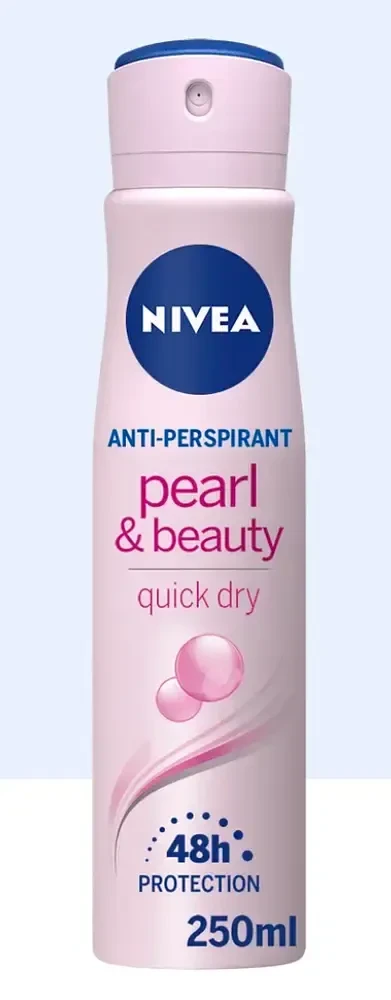
Nivea Pearl & Beauty Anti-Perspirant Deodorant Spray by Nivea
Nivea

Nivea Pearl & Beauty Anti-Perspirant Deodorant Spray

Deodorantbody care

Safety score

Pregnancy-focused assessment

Low Risk74/100
Higher concernLower concern

One or more ingredients have a low-risk flag in MamaSkin's current assessment. Review the notes and your own circumstances.

Formula and assessment check

Ingredient safety review updated 15 February 2026. Product formulas can change, so compare the ingredients shown here with the packaging you have.

Report a formula mismatch

MamaSkin assessment · 15 February 2026

Is Nivea Pearl & Beauty Anti-Perspirant Deodorant Spray suitable during pregnancy?

MamaSkin currently classifies Nivea Pearl & Beauty Anti-Perspirant Deodorant Spray as Low risk, with a stored score of 74/100. This is a precautionary classification, not an unqualified pregnancy-safe recommendation. Read the ingredient context and any manual-review explanation below.

What does the ingredient evidence show?

The recorded formula includes 4 ingredient entries with risk flags: Butane (Low risk), Cyclomethicone (Low risk), Parfum (Low risk), plus others listed in the breakdown. These are ingredient-level flags; they do not replace the stored product assessment or account for every formulation detail.

16 of 16 ingredient entries on this page have a recorded score, evidence summary and source text. That describes documentation coverage, not proof that the finished formula has been clinically tested during pregnancy.

Ingredient breakdown

See how the listed formula falls across MamaSkin's pregnancy-focused risk bands.

12

No known risks

4

Low risk

0

Medium risk

0

High risk

Ingredients

Ingredients with a higher risk flag appear first, followed by the rest of the formula.

Parfum

Low Risk

Umbrella term for an undisclosed fragrance blend. It’s not usually a pregnancy-specific concern at normal cosmetic use levels, but the exact components and concentrations aren’t fully disclosed on the label, so we score it more conservatively. If you prefer maximum transparency (or you’re sensitive to fragrance compounds), choose fragrance-free/unscented products.

Sources: SCCS: Fragrance allergens in cosmetic products https://health.ec.europa.eu/latest-updates/sccs-new-opinion-fragrance-allergens-cosmetic-products-2012-07-31_en
Butane

Low Risk

Butane is used in cosmetics mainly as an aerosol propellant rather than a leave-on active ingredient. Available cosmetic safety assessments do not point to meaningful toxicity under normal conditions of use, so routine incidental exposure from standard cosmetic products fits a low-risk classification; the more serious pregnancy concerns relate to intentional inhalant abuse with high exposure, not ordinary cosmetic use.

Sources: CIR: Butane ingredient safety information https://www.cir-safety.org/ingredient/butane

Cyclomethicone

Low Risk

A generic name for volatile cyclic siloxane mixtures used for slip and quick-drying texture. Cosmetic reviews have supported cyclomethicone use, but the generic label may encompass D4, D5 or related cyclic siloxanes with different reproductive, impurity and spray-route evidence. MamaSkin classifies the generic ingredient as low risk because its exact composition is not disclosed.

Sources: CIR: Cyclomethicone https://cir-safety.org/ingredient/cyclomethicone; European Commission SCCS: Opinion on Cyclopentasiloxane (D5) in Cosmetic Products https://health.ec.europa.eu/publications/decamethylcyclopentasiloxane-cyclopentasiloxane-d5-cosmetic-products_en; European Commission SCCP: Cyclomethicone D4 request https://ec.europa.eu/health/ph_risk/committees/04_sccp/docs/sccp_q_188.pdf

Show all (16)

Dimethicone

Low Risk

Dimethicone is a silicone polymer used as a skin protectant and slip/conditioning agent. It is considered inert with minimal dermal absorption; the main practical issues are cosmetic (feel) and occasional irritation in very sensitive users. It is not a pregnancy-specific concern in topical cosmetic use.

Sources: CIR: Amended Safety Assessment of Dimethicone, Methicone, and Substituted-Methicone Polymers as Used in Cosmetics https://cir-safety.org/supplementaldoc/amended-safety-assessment-dimethicone-methicone-and-substituted-methicone-polymers-2

Isobutane

No Known Risks

A volatile hydrocarbon used mainly as an aerosol propellant. Cosmetic safety reviewers concluded that isobutane and propane are safe in current cosmetic practices. Use aerosols with ventilation and away from heat or flame.

Sources: CIR: Hydrocarbon propellants conclusion, IJT 44(Suppl. 1), 2025; December 2025 Quick Reference Table https://cir-safety.org/sites/default/files/QRT-Update-Dec2025.pdf

Propane

No Known Risks

A volatile hydrocarbon used mainly as an aerosol propellant. Cosmetic safety reviewers concluded that isobutane and propane are safe in current cosmetic practices. Use aerosols with ventilation and away from heat or flame.

Sources: CIR: Hydrocarbon propellants conclusion, IJT 44(Suppl. 1), 2025; December 2025 Quick Reference Table https://cir-safety.org/sites/default/files/QRT-Update-Dec2025.pdf

Aluminum Chlorohydrate

No Known Risks

aluminum chlorohydrate is an aluminium antiperspirant ingredient. SCCS concluded that aluminium compounds are safe at the maximum cosmetic-use levels it assessed, with particle-size conditions for sprays. No pregnancy-specific concern was identified for compliant topical use. This classification does not cover nano forms; avoid inhaling airborne product.

Sources: SCCS Opinion on the Safety of Aluminium in Cosmetic Products - Submission IV SCCS/1662/23 https://health.ec.europa.eu/publications/safety-aluminium-cosmetic-products-submission-iv_en

Isopropyl Palmitate

No Known Risks

This emollient ester improves slip and skin feel. Cosmetic Ingredient Review assessments support use in current cosmetic concentrations when formulated to be non-irritating; topical use is not identified as a pregnancy- or breastfeeding-specific concern. Some alkyl esters can increase penetration of other formula ingredients.

Sources: CIR: Safety Assessment of Alkyl Esters as Used in Cosmetics https://cir-safety.org/supplementaldoc/safety-assessment-alkyl-esters-used-cosmetics

Hydrolyzed Pearl

No Known Risks

hydrolyzed pearl is an amino acid, peptide, protein-related or glycosaminoglycan cosmetic conditioning ingredient. Expected systemic exposure from normal topical use is low, and relevant cosmetic-family assessments did not identify a pregnancy-specific concern. Manufacturing quality and residual allergenic proteins remain relevant where applicable.

Sources: CIR assessments of alpha-amino acids, plant-derived amino acids, proteins and peptides https://www.cir-safety.org/supplementaldoc/safety-assessment-%CE%B1-amino-acids-used-cosmetics; European Commission CosIng

Persea Gratissima Oil

No Known Risks

Avocado-derived emollient oil used for skin conditioning and barrier feel. Normal topical cosmetic use has no known pregnancy- or breastfeeding-specific concern identified in reviewed cosmetic references.

Sources: CIR: Safety Assessment of Plant-Derived Fatty Acid Oils as Used in Cosmetics; EU CosIng / cosmetics regulatory inventory

Octyldodecanol

No Known Risks

Fatty alcohol emollient used to improve spreadability and reduce drag. Reviewed cosmetic safety sources support normal topical use, with no pregnancy- or breastfeeding-specific topical signal identified in the material reviewed.

Sources: CIR ingredient status / report data sheet for Octyldodecanol; EU CosIng / cosmetics regulatory inventory

Disteardimonium Hectorite

No Known Risks

Mineral-derived organoclay thickener and suspension agent used in creams, makeup and sunscreens. It is expected to have low systemic exposure from topical use, with no pregnancy- or breastfeeding-specific concern identified in reviewed cosmetic references.

Sources: CIR cosmetic ingredient safety references for hectorite/quaternium hectorite ingredients; EU CosIng / cosmetics regulatory inventory

Propylene Carbonate

No Known Risks

Solvent and viscosity-control ingredient used in cosmetic formulas, often with clay thickeners. Reviewed cosmetic ingredient references do not identify a pregnancy- or breastfeeding-specific concern for normal topical use.

Sources: CIR cosmetic ingredient safety references for carbonate solvents; EU CosIng / cosmetics regulatory inventory

Dimethiconol

No Known Risks

A high-molecular-weight silicone polymer used for film forming, smoothing and skin or hair conditioning. The Cosmetic Ingredient Review concluded that Dimethiconol and its assessed derivatives are safe in current cosmetic use. Its polymeric nature limits skin penetration, and available evidence does not identify a pregnancy- or breastfeeding-specific concern for normal topical exposure.

Sources: CIR: Safety Assessment of Dimethiconol and its Esters and Reaction Products; International Journal of Toxicology 36(Suppl. 3):31-50 (2017) https://cir-safety.org/ingredient/dimethiconol

Geraniol

No Known Risks

A floral fragrance ingredient found in several essential oils and also used in manufactured form. It is a recognised contact allergen, but no pregnancy-specific hazard is identified for normal topical cosmetic exposure.

Sources: European Commission: Fragrance allergens labelling https://single-market-economy.ec.europa.eu/sectors/cosmetics/cosmetic-products-specific-topics/fragrance-allergens-labelling_en; SCCS fragrance-allergen opinions

Benzyl Alcohol

No Known Risks

Benzyl alcohol is used as a preservative and fragrance component in cosmetics; it is not a pregnancy-specific concern at typical topical exposure, but it can be irritating or sensitising for some individuals, particularly in leave-on products.

Sources: CIR; EU/UK Cosmetics Regulation; toxicology reviews

Formulations can change without notice. For the most accurate result, compare this list with your packaging and scan the exact ingredient label in MamaSkin when you repurchase.

Questions about this assessment

Has every ingredient in Nivea Pearl & Beauty Anti-Perspirant Deodorant Spray been assessed?

16 of 16 ingredient entries on this page have a recorded score, evidence summary and source text. That describes documentation coverage, not proof that the finished formula has been clinically tested during pregnancy.

Does this assessment apply to the Nivea Pearl & Beauty Anti-Perspirant Deodorant Spray I have?

Only if the ingredient list on your packaging matches the recorded formula shown here. Formulas can differ by market and change over time. Compare the full list, not just the product name; report a mismatch if it differs.

Does this pregnancy assessment also establish breastfeeding suitability?

No. This page presents a pregnancy-focused product assessment. Do not infer a breastfeeding conclusion from its score or label; breastfeeding requires a separate assessment of the formula and how it is used.

How to use this assessment

The risk band is the primary conclusion. The score adds detail within that band and should not be used to compare products as if a one-point difference were clinically meaningful.

MamaSkin provides pregnancy-focused information, not medical advice. Your midwife, GP, pharmacist or dermatologist should take priority when your circumstances differ from typical cosmetic use.

Read the full methodology