A note from us
A little clarity for a changing chapter.
Pregnancy can make a familiar skincare shelf feel full of new questions. Do all your actives need to go? What does a pregnancy claim actually tell you? And what changes once you’re breastfeeding?
We put those questions to Professor Caitriona Ryan, consultant dermatologist and advisor to SKN TO SKN. Here, she shares her approach to ingredients, formulation and caring for your skin through pregnancy and beyond.
With care, Simone & Martina
This interview was created in collaboration with SKN TO SKN. Prof Ryan advises the brand and helped formulate its products. MamaSkin’s ingredient assessments remain independent.
“Pregnancy safe skincare absolutely does not have to mean ineffective skincare.”
Active skincare during pregnancy
MamaSkin asksWhat are the most common misconceptions you hear about skincare during pregnancy, and what would you most like to clarify?
Professor Caitriona Ryan
The biggest misconception is that pregnancy means you have to stop using active skincare altogether. Women can become understandably anxious about ingredients and sometimes strip their routine back so far that they are no longer addressing concerns such as acne, pigmentation, dehydration or loss of radiance. Pregnancy safe skincare absolutely does not have to mean ineffective skincare.
There are certain ingredients that should be removed, most importantly retinoids. Topical retinoids are avoided during pregnancy and when planning a pregnancy as a precaution because systemic absorption is possible, even though it is very low. But there are many excellent ingredients that women can continue to use, including hyaluronic acid, niacinamide, azelaic acid, peptides and appropriate antioxidants. Azelaic acid, for example, is considered an appropriate option for acne during pregnancy.
I would love women to move away from thinking about pregnancy skincare as a long list of things they cannot use. It is much more useful to think about what the skin needs at that particular stage. Hormonal changes can increase acne, pigmentation, sensitivity and dryness, so the focus should be on strengthening the skin barrier, maintaining hydration, controlling inflammation and protecting against pigmentation, while still supporting collagen and overall skin quality.
That philosophy was one of the things I particularly liked when helping to formulate SKN TO SKN. It was not about creating bland skincare that was simply acceptable during pregnancy. The aim was to create genuinely effective skincare using intelligent alternatives to ingredients that need to be paused, so that women can continue caring for their skin through pregnancy and well beyond it.
What pregnancy safe should mean
MamaSkin asksWhen a product is described as “pregnancy safe”, what evidence and formulation considerations should sit behind that description?
Professor Caitriona Ryan
I think the term pregnancy safe should carry real responsibility. It should mean much more than simply removing retinol from a formula.
Every ingredient should be assessed in the context of its toxicological profile, concentration, potential for absorption, route of exposure and the way the finished product will actually be used. A rinse off cleanser, for example, represents a very different exposure from a serum applied twice daily and left on the entire face. Similarly, a body product used across a large surface area needs to be considered differently from a small amount of eye cream.
It is also important to consider the finished formulation rather than simply producing a checklist of supposedly good and bad ingredients. Under European cosmetics legislation, the safety assessment of a finished cosmetic must consider its intended use and anticipated systemic exposure to the individual ingredients within that final formulation. The amount applied, frequency of use, surface area and population exposed all form part of that assessment.
For me, a well designed pregnancy skincare product should then go beyond safety. It should answer the problems that women actually experience during pregnancy, whether that is increased pigmentation, breakouts, sensitivity, dehydration or changes in the skin barrier. Safety is the starting point. Efficacy still matters.
One ingredient name. A fuller picture.
- The ingredientIts properties and evidence
- The concentrationHow much is in the formula
- The exposureWhere, how often, how long
- The finished productHow it all comes together
The ingredient and the whole formula
MamaSkin asksHow should readers interpret research about an individual ingredient alongside information about the finished product, including concentration and how it is used?
Professor Caitriona Ryan
This is such an important point because skincare information online often reduces an ingredient to either “safe” or “unsafe”, when the science is rarely that simplistic.
An ingredient study tells us something about that particular ingredient at a particular concentration, in a particular formulation and under particular conditions. It does not automatically mean that every product containing that ingredient will produce the same result.
Concentration matters enormously, but so do the vehicle, absorption, how much product is applied, how frequently it is used, whether it is rinsed off or left on, where it is applied and the condition of the skin barrier. The European safety framework specifically requires exposure to be considered in relation to the amount of product, frequency, duration, application site and surface area.
This is why I encourage women not to become frightened by individual ingredient names they see on social media. Look at the whole formulation and the intended use. Equally, the presence of one fashionable ingredient does not automatically make a product effective. Good skincare formulation is about how ingredients work together, at appropriate concentrations, within a stable and well tolerated finished product.
A routine that works for your skin
MamaSkin asksFor someone building a straightforward pregnancy skincare routine, what would you prioritise, and when would you recommend individual advice?
Professor Caitriona Ryan
I would keep the routine beautifully simple. Start with a gentle cleanser that does not strip the skin barrier. Follow with a well formulated serum addressing your main concerns, then a moisturiser containing barrier supportive and hydrating ingredients, and finish every morning with broad spectrum sun protection.
Start with what your skin needs.
- 01CleanseGentle on the barrier
- 02TreatFocus on your concerns
- 03MoisturiseSupport and hydrate
- 04ProtectBroad-spectrum SPF
I particularly like niacinamide for barrier support, redness and uneven tone, hyaluronic acid for hydration, azelaic acid or an appropriate derivative for inflammation, blemishes and pigmentation, and peptides and antioxidants for women who want to continue supporting collagen while retinoids are paused.
This was the thinking behind the SKN TO SKN Multitasking Serum, which I helped formulate. It combines peptides and astaxanthin with hyaluronic acid and an azelaic acid derivative. I think this type of formulation is particularly useful because pregnancy does not mean that your collagen banking journey or your interest in skin longevity has to stop. It simply requires different ingredients.
 Product check
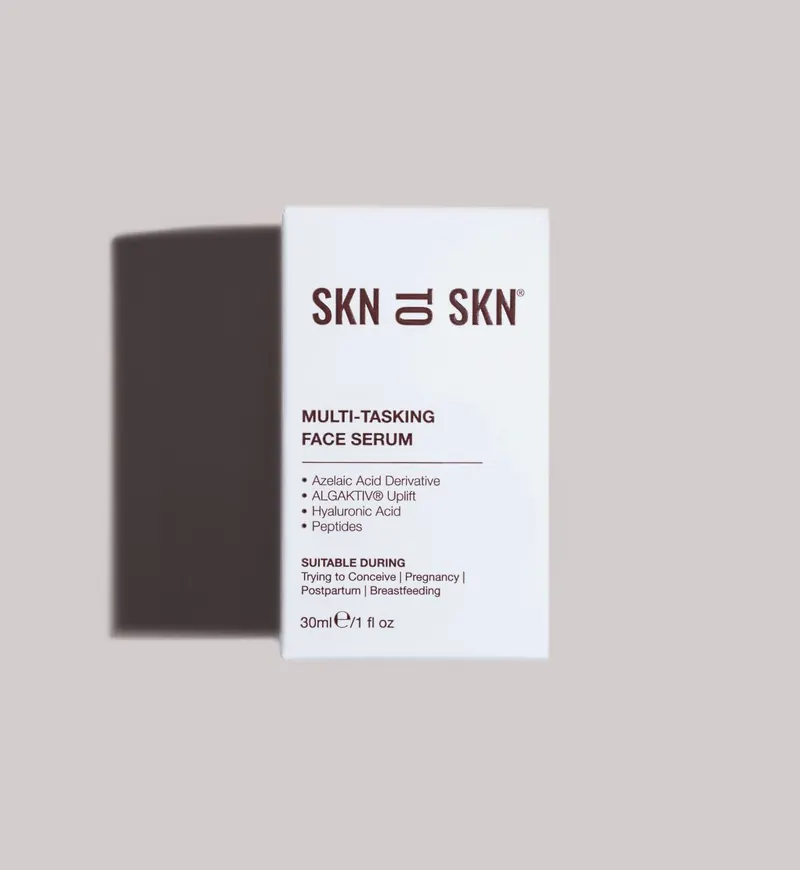
SKN TO SKN
Multi-Tasking Face Serum
Pregnancy assessment
No known risks
Based on the recorded ingredients
See what’s inside your skincare, with ingredient assessments and the evidence behind them.
Explore in MamaSkinIn this formula26 ingredients
Explore the full ingredient list
- Aqua (Water)No known risks
- Coco-CaprylateNo known risks
- MethylpropanediolNo known risks
- Potassium Azeloyl DiglycinateNo known risks
- Simmondsia Chinensis (Jojoba) Seed OilNo known risks
- PropanediolNo known risks
- GlycerinNo known risks
- Polyacrylate Crosspolymer-6No known risks
- Tocopheryl AcetateNo known risks
- Lauryl GlucosideNo known risks
- Polyglyceryl-6 LaurateNo known risks
- Caprylyl GlycolNo known risks
- Myristyl GlucosideNo known risks
- Haematococcus Pluvialis ExtractNo known risks
- Sodium Stearoyl GlutamateNo known risks
- Xanthan GumNo known risks
- Tetrasodium Glutamate DiacetateNo known risks
- TocopherolNo known risks
- PhenylpropanolNo known risks
- Sodium HyaluronateNo known risks
- Citric AcidNo known risks
- Vaccinium Macrocarpon (Cranberry) Fruit ExtractNo known risks
- Glycine Soja (Soybean) OilNo known risks
- 1,2-HexanediolNo known risks
- Portulaca Oleracea ExtractNo known risks
- Palmitoyl Pentapeptide-4No known risks
Where niacinamide appears SKN TO SKN confirmed that it’s in its Glow & Go Daily Moisturiser with Mineral SPF 30.
MamaSkin pregnancy assessment · Ingredient records checked 3 November 2026. The assessment is independent of this collaboration and is not a guarantee of suitability. How we assess ingredients.
Sun protection is especially important because pregnancy can significantly increase susceptibility to melasma. I particularly favour tinted mineral sunscreens containing zinc oxide and iron oxides for women prone to pigmentation, as the tint can also help protect against visible light.
Individual advice becomes important if someone has significant acne, eczema, rosacea, melasma or another inflammatory skin condition, is using prescription treatment, develops an unexpected rash, or simply is not sure whether an existing product is appropriate. Pregnancy is not a time when women should feel they have to struggle with a skin condition because they are frightened to treat it. There are usually safe treatment options available, and a dermatologist can help choose them.
After birth and while breastfeeding
MamaSkin asksWhat should someone revisit in their skincare routine after birth and during breastfeeding?
Professor Caitriona Ryan
The postpartum period deserves almost as much attention as pregnancy because the skin can change again very quickly. Oestrogen and progesterone levels fall after delivery and women may suddenly notice increased dryness, sensitivity, acne, pigmentation or simply skin that looks less rested at exactly the time when sleep is in short supply.
The first thing I would do is reassess rather than automatically return to the exact routine you had before pregnancy. Your skin may now have completely different needs. Continue supporting hydration and the skin barrier, maintain daily sunscreen, particularly if pregnancy related melasma remains, and then gradually reintroduce other actives according to your skin concerns.
Breastfeeding also needs to be considered separately from pregnancy. Not every ingredient that is avoided during pregnancy automatically needs to remain off limits throughout breastfeeding. The level of systemic absorption and the possibility of transfer into breast milk or direct contact with the baby all matter. For example, LactMed considers topical tretinoin to represent a low risk to the nursing infant because it is poorly absorbed through the skin, but it should never be applied to the nipple or areola and the baby should not come into contact with treated skin. Guidance can differ between individual retinoid products, so I recommend discussing prescription actives with your dermatologist when restarting them.
It is also worth remembering that there is no urgency to abandon a pregnancy suitable routine simply because the baby has arrived. If your skin is thriving on peptides, antioxidants, niacinamide, hyaluronic acid, azelaic acid and barrier supportive ingredients, there is every reason to continue them. In fact, this is why I see SKN TO SKN much more broadly than simply as a pregnancy skincare range.
The formulations were designed to support hormonal, sensitive and changing skin through pregnancy, postpartum and beyond, and many of the ingredients are exactly the ones I recommend for healthy skin at any life stage.
After birth
What to revisit in your routine
- Keep the basics
- Hydration, skin barrier care and daily sun protection.
- Review treatments
- Ask about the specific product, how much is absorbed and where your baby might touch treated skin.
Meet the contributor
Professor Caitriona Ryan
MD, FRCPI, FAAD
Professor Caitriona Ryan is a consultant dermatologist, co-founder of the Institute of Dermatologists in Dublin, and a Clinical Professor at University College Dublin. She advises SKN TO SKN and helped formulate its skincare products.
Read her professional biographySources & further reading
References for the guidance discussed in this conversation, added by MamaSkin.
- European Medicines Agency · Retinoids during pregnancy
- American Academy of Dermatology · Acne treatment during pregnancy
- LactMed · Tretinoin and breastfeeding
- American Academy of Dermatology · Melasma and sun protection
- SKN TO SKN · Serum ingredients
- SKN TO SKN · Glow & Go moisturiser ingredients
These are general perspectives and do not replace individual medical advice. Speak to your clinician before changing prescription treatment.