
A closer look, from MamaSkin
After pregnancy, what changes for your skincare?
Can that favourite serum come back? Let’s look at what changes while breastfeeding.
8 topical actives · Sources checked
You shouldn’t have to start from scratch
You might have put a favourite serum away when you became pregnant. Now you’re breastfeeding, and you’re wondering whether it can come back.
We want MamaSkin to help you answer that question without sending you back to the beginning of your research. A pregnancy warning can follow a bottle around long after the reason for that warning has changed.
So we went back to the sources. We compared pregnancy guidance with eight LactMed entries for topical acne and pigmentation treatments. We looked for what each recommendation actually rests on, and what it means when you’re standing in front of your bathroom shelf.
The useful questions were surprisingly practical: which active, how much skin, and could baby touch it? Here’s what we found, with the gaps left visible.
With care,
Simone & MartinaMamaSkin founders
Why pregnancy advice doesn’t simply carry over
Pregnancy and breastfeeding involve different routes of exposure. A recommendation about a developing baby during pregnancy doesn’t answer every question about a product used after birth.
During breastfeeding, a source may consider how much of a topical treatment is absorbed into your body, whether it could reach milk, and what that might mean for your baby. It may also give advice about contact with treated skin. Those are different questions, and both matter.
This is why we keep pregnancy and breastfeeding assessments separate at MamaSkin. A cautious pregnancy recommendation isn’t an automatic breastfeeding ban. Equally, a reassuring sentence about one topical medicine isn’t permission to restart every product in the same ingredient family.
If you’re breastfeeding and pregnant again, both contexts apply. Tell your pharmacist or prescriber rather than using the breastfeeding information on its own.
Two ways to think about exposure
When we read the references, we found it helped to separate these two paths. This is a guide to the questions, not a measurement of how much reaches a baby.
Through your body
Treated skin → absorption → possible transfer into milk
What do we know about absorption and milk levels for this particular active?
Through direct contact
Treated skin → baby’s skin or mouth
Could baby touch, lick or feed against the area where the product was applied?
A face treatment and a treatment applied to the nipple are not the same situation. Low expected absorption doesn’t remove the need to think about where a product goes.
For topical acne treatments, MotherToBaby advises avoiding the nipple and areola, washing hands after application, and washing off treatment applied to the breast or chest before feeding. Follow the instructions for your own medicine as well.
What the breastfeeding references focus on
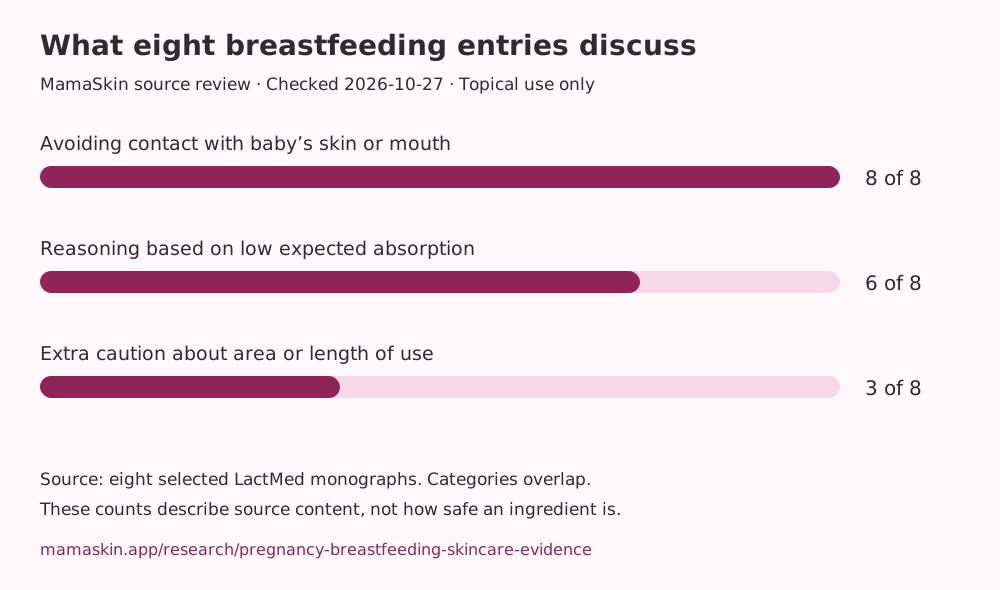
We read one LactMed entry for each active. Here’s what those eight entries discuss.
| Topic | Entries out of eight |
|---|---|
| Avoiding contact with baby’s skin or mouth | 8 |
| Reasoning based on low expected absorption | 6 |
| Extra caution about area or length of use | 3 |
A recommendation isn’t always a milk measurement
None of these 8 entries reports measured milk levels after topical use. That doesn’t establish harm or prove safety. Recommendations can also draw on absorption and likely exposure.
Find the active on your shelf
Start with the exact name on the ingredient list or prescription. These eight comparisons cover use on the skin, including some medicines. Open an ingredient for its pregnancy and breastfeeding context.
Azelaic acid
- During pregnancy
- An OTC option if treatment is needed, according to MotherToBaby’s summary of ACOG guidance.
- While breastfeeding
- LactMed considers topical use low risk because little is absorbed. Keep it off the breast and away from baby’s skin.
Sources: MotherToBaby · LactMed: Azelaic acid (revised 15 March 2026)
More on azelaic acid in pregnancyBenzoyl peroxide
- During pregnancy
- An OTC option if needed. AAD also advises discussing and limiting its use during pregnancy.
- While breastfeeding
- LactMed considers topical use low risk because absorption is limited. Avoid contact between baby’s skin and treated areas.
Sources: MotherToBaby · American Academy of Dermatology · LactMed: Benzoyl peroxide (revised 15 November 2024)
More on benzoyl peroxide in pregnancySalicylic acid
- During pregnancy
- An OTC option if needed. AAD flags strengths above 2% for discussion and limited use.
- While breastfeeding
- LactMed expects little absorption from topical use. Avoid areas baby could touch or lick. This does not cover oral salicylates.
Sources: MotherToBaby · American Academy of Dermatology · LactMed: Salicylic acid (revised 21 June 2021)
More on salicylic acid in pregnancyGlycolic acid
- During pregnancy
- An OTC option if treatment is needed. A routine skincare product is different from a professional peel.
- While breastfeeding
- LactMed expects little absorption from topical use. Avoid areas baby could touch or lick; the entry has no direct clinical lactation data.
Sources: MotherToBaby · LactMed: Glycolic acid (revised 16 August 2021)
More on glycolic acid in pregnancyTretinoin
- During pregnancy
- Topical tretinoin is generally avoided during pregnancy.
- While breastfeeding
- LactMed considers topical use low risk because absorption is poor. Its entry reports no breastfeeding studies. Discuss restarting with your prescriber; keep it off the nipple and areola and away from baby’s skin.
Sources: MotherToBaby · LactMed: Tretinoin (revised 15 October 2024)
More on tretinoin in pregnancyAdapalene
- During pregnancy
- Topical adapalene is generally avoided during pregnancy.
- While breastfeeding
- LactMed judges topical use probably low risk. It advises the smallest area and shortest time, avoiding the nipple and baby’s skin. Discuss use with your clinician.
Sources: MotherToBaby · LactMed: Adapalene (revised 15 June 2025)
More on adapalene in pregnancyTazarotene
- During pregnancy
- AAD lists tazarotene among the ingredients to avoid during pregnancy.
- While breastfeeding
- Expert advice differs: LactMed describes advice to avoid large areas and advice to avoid it altogether. Discuss alternatives with your prescriber. Prevent infant contact if used.
Sources: American Academy of Dermatology · LactMed: Tazarotene (revised 15 October 2024)
More on tazarotene in pregnancyHydroquinone
- During pregnancy
- AAD lists hydroquinone among the ingredients to avoid during pregnancy.
- While breastfeeding
- LactMed says some experts discourage long-term use; its entry reports no breastfeeding studies. Discuss the plan with your clinician and prevent baby touching or ingesting treated skin.
Sources: American Academy of Dermatology · LactMed: Hydroquinone (revised 15 March 2026)
More on hydroquinone in pregnancyStrength, where you apply it and the rest of the formula matter. These notes don’t clear every product or peel containing an ingredient, and don’t cover medicines taken by mouth. Ask your clinician before starting, stopping or restarting a treatment.
What about retinol, retinal and prescription retinoids?
This is where a broad ingredient label can get in the way. Retinol, retinal, tretinoin, adapalene and tazarotene are different substances. A discussion of one does not automatically cover the others, or a tablet taken by mouth.
LactMed’s topical tretinoin entry considers it low risk because absorption through the skin is poor, while also making clear that breastfeeding studies are lacking. Its advice includes keeping treatment away from the nipple and preventing contact with baby’s skin.
Adapalene’s entry also draws on low absorption, with advice to minimise the area and duration of use. Tazarotene has a different discussion, including differing expert views and treatment-area cautions. That variation is exactly what gets lost in a single “retinoids: yes or no” answer.
Our chart does not include cosmetic retinol or retinal monographs. We haven’t turned the tretinoin finding into a blanket clearance for those serums. For the fuller comparison, read our retinol, retinal and tretinoin breastfeeding guide.
If you paused a prescription, take the exact product and strength back to your prescriber. That gives them something concrete to review, including whether restarting it makes sense for your skin now.
When a source says “not studied”
We know that phrase can feel like being left with no answer. It helps to ask what is missing: milk measurements, infant outcomes, or studies of a particular formulation?
In these eight entries, no reported milk measurement after topical use met our definition. That finding belongs to this source set. It does not mean no skincare ingredient has ever been measured in milk, or that every ingredient behaves alike.
A recommendation may still draw on other information, such as absorption through skin. That is useful evidence, with a different kind of uncertainty from a study that directly measures milk after treatment. We want those differences to stay visible rather than turn them into a reassuring score.
Hydroquinone illustrates why the wording matters. Its entry does not describe breastfeeding research establishing safety, and notes that some experts find long-term use difficult to justify in a nursing mother. That is a reason for an individual discussion, not a conclusion that every pigmentation treatment has the same issue.
Other pigmentation ingredients need their own review. Alpha-arbutin and thiamidol, for example, are not part of this eight-entry chart. We haven’t used the hydroquinone entry to assign either a breastfeeding recommendation. Bring the exact active to your pharmacist rather than treating all brightening ingredients as interchangeable.
A small checklist before you bring it back
You don’t need to arrive at an appointment with a research folder. A photo of the bottle, its full ingredient list and a few details about how you use it are a helpful start.
- Name the product and active. Include the strength if it is given. A combination treatment needs every active checked, not just the one on the front.
- Describe the area and frequency. A small facial application, a body treatment and a professional peel can involve very different use. Mention irritated or broken skin rather than assuming the usual absorption discussion covers it.
- Think about cuddles and feeding. Where could baby’s mouth or skin touch the treated area? Ask what precautions are needed for that specific product.
- Bring your baby’s context. Let the clinician know their age, whether they were premature, and any health concerns. A general ingredient page cannot account for all of that.
A useful question is: “Can I use this product while breastfeeding, at this strength and on this area?” It gives your pharmacist or prescriber much more to work with than asking whether an entire ingredient family is safe.
And if your current routine is just cleanser, moisturiser and sunscreen, there’s no deadline to make it more complicated. We’re building MamaSkin to make the next decision easier whenever you want to make it.
Our sources, and a little context
We selected four OTC acne actives, three topical retinoid medicines and hydroquinone. This is a focused source review, not a clinical study or a systematic review of all skincare research. No customer data is used.
How we compared them
For pregnancy, we used the two references below. For breastfeeding, we read each ingredient’s LactMed summary and milk-level section. All eight LactMed entries are linked above, with their revision dates. Sources were checked on 27 October 2026; their own revision dates vary.
We counted explicit advice about infant contact; reasoning based on low expected absorption; and extra cautions about treatment area, duration or long-term use. The last category includes different cautions, not a common risk rating. A topic absent from an entry is not proof it is irrelevant.
The milk finding concerns measurements after topical treatment reported in these entries. Normal background levels of azelaic acid and blood measurements for adapalene don’t meet that definition. We did not independently search every clinical study.
- MotherToBaby: Topical Acne TreatmentsRevised 1 February 2026
- American Academy of Dermatology: Pregnancy skin careRevised 26 June 2025
For MamaSkin’s wider ingredient review process, read our assessment methodology.
If you share it, keep its source, date and context attached, and link to this review.