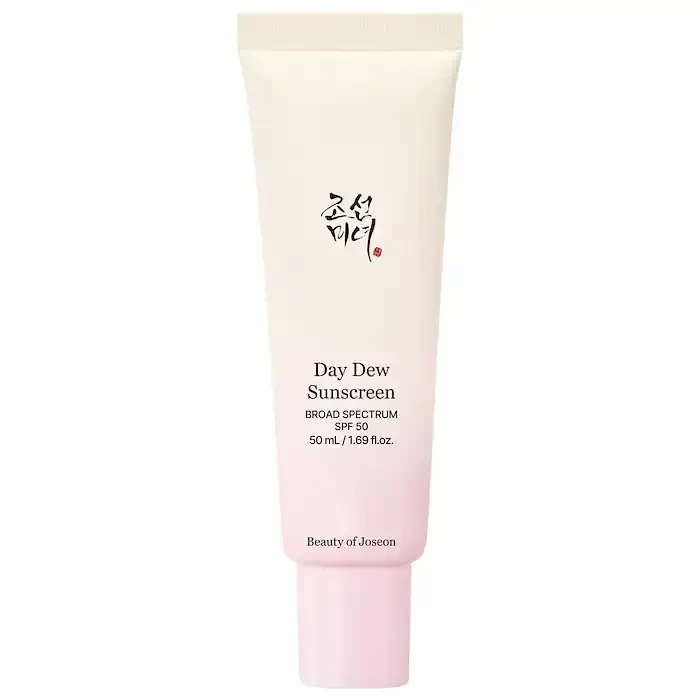
Beauty of Joseon Day Dew Sunscreen SPF 50 by Beauty of Joseon
Beauty of Joseon

Beauty of Joseon Day Dew Sunscreen SPF 50

Sunscreens

Safety score

Pregnancy-focused assessment

Medium Risk51/100
Higher concernLower concern

This formula contains an ingredient that needs extra caution in MamaSkin's pregnancy-focused assessment.

Formula and assessment check

Ingredient safety review updated 23 November 2025. Product formulas can change, so compare the ingredients shown here with the packaging you have.

Report a formula mismatch

MamaSkin assessment · 23 November 2025

Is Beauty of Joseon Day Dew Sunscreen SPF 50 suitable during pregnancy?

MamaSkin currently classifies Beauty of Joseon Day Dew Sunscreen SPF 50 as Medium risk, with a stored score of 51/100. This assessment flags concerns that need closer consideration. Review the explanation with a qualified healthcare professional before deciding whether to use this formula during pregnancy.

What does the ingredient evidence show?

The recorded formula includes 7 ingredient entries with risk flags: Butyl Methoxydibenzoylmethane (Medium risk), Homosalate (Medium risk), Ethylhexyl Salicylate (Low risk), plus others listed in the breakdown. These are ingredient-level flags; they do not replace the stored product assessment or account for every formulation detail.

24 of 24 ingredient entries on this page have a recorded score, evidence summary and source text. That describes documentation coverage, not proof that the finished formula has been clinically tested during pregnancy.

Ingredient breakdown

See how the listed formula falls across MamaSkin's pregnancy-focused risk bands.

17

No known risks

4

Low risk

3

Medium risk

0

High risk

Ingredients

Ingredients with a higher risk flag appear first, followed by the rest of the formula.

Butyl Methoxydibenzoylmethane

Medium Risk

Butyl methoxydibenzoylmethane (avobenzone) is a UVA filter used in sunscreens. Reviews note potential endocrine-related signals for several organic UV filters, but data are often not sufficient to establish endocrine disruption, and systemic exposure depends on formulation and use pattern. Pregnancy-specific human outcome data for topical exposure are limited; the key signal is uncertainty around systemic/endocrine effects rather than a well-defined pregnancy outcome dataset.

Sources: TGA: Safety review of seven active sunscreen ingredients https://www.tga.gov.au/resources/publication/corporate-reports/safety-review-seven-active-sunscreen-ingredients
Homosalate

Medium Risk

Homosalate is a UV-B filter. SCCS re-evaluations focused on potential endocrine activity and systemic exposure; while endocrine evidence has been described as inconclusive/equivocal, the ingredient remains under endocrine-disruptor scrutiny and exposure modelling depends on product type and use patterns. Pregnancy-specific human outcome data for topical exposure are limited, so the key signal is endocrine uncertainty plus systemic exposure considerations with frequent, large-area use.

Sources: SCCS: Homosalate safety assessment https://health.ec.europa.eu/publications/scientific-advice-safety-homosalate-cas-no-118-56-9-ec-no-204-260-8-uv-filter-cosmetic-products_en

Octocrylene

Medium Risk

Octocrylene is a UV filter and photostabiliser used in sunscreens and some daily SPF products. SCCS reviewed endocrine-related evidence and noted some indications of endocrine effects in vivo, but with limitations; systemic exposure is plausible with frequent, large-area use. An additional practical signal is that benzophenone can occur as an impurity/degradation product in some octocrylene-containing products. Pregnancy-specific human outcome data for topical exposure are limited.

Sources: SCCS/1627/21: Octocrylene https://health.ec.europa.eu/publications/octocrylene_en

Show all (24)

Ethylhexyl Salicylate

Low Risk

Ethylhexyl salicylate (octisalate) is an organic UV-B filter with measurable topical absorption. A CIR review records a rat oral reproductive/developmental study with dose-related post-implantation loss and smaller litters at 80 and 250 mg/kg/day (NOAEL 25 mg/kg/day); those repeated oral doses do not model intact-skin cosmetic exposure. The same review found relatively low human-skin permeability and concluded ethylhexyl salicylate safe in the assessed cosmetic uses. A ToxCast-to-human-exposure comparison found the most sensitive in-vitro endocrine response at about 16.5 micromolar versus about 0.023 micromolar maximal-use human plasma exposure, roughly 700-fold lower. FDA still requests additional sunscreen safety data, and pregnancy-outcome data are limited; MotherToBaby reports no proven increased pregnancy risk. MamaSkin therefore uses Low Risk to surface absorption and the evidence gap without treating remote high-dose animal findings as proof that typical topical use should be avoided.

Sources: CIR 2019 Final Report: Amended Safety Assessment of Salicylic Acid and Salicylates https://www.cir-safety.org/sites/default/files/salicy042019FAR.pdf, Toxicological Sciences 2023: ToxCast/Tox21 endocrine activity compared with human plasma exposure https://academic.oup.com/toxsci/article/196/1/25/7240499, FDA: OTC sunscreen proposed-order Q&A https://www.fda.gov/drugs/understanding-over-counter-medicines/questions-and-answers-fda-posts-deemed-final-order-and-proposed-order-over-counter-sunscreen, Matta et al. JAMA 2020 maximal-use sunscreen absorption trial https://jamanetwork.com/journals/jama/fullarticle/2759002, MotherToBaby: Screening Your Sunscreen During Pregnancy https://mothertobaby.org/baby-blog/screening-your-sunscreen-during-pregnancy/

Phenoxyethanol

Low Risk

Phenoxyethanol is a preservative permitted in EU cosmetics up to 1.0%. The SCCS concluded it is safe for cosmetic use at that level, including when considering higher cosmetic exposure scenarios in infants and young children. Main practical concern is irritation/stinging on very sensitive or compromised skin rather than a pregnancy- or breastfeeding-specific risk.

Sources: SCCS/1575/16: Phenoxyethanol opinion https://health.ec.europa.eu/publications/phenoxyethanol_en

Dimethicone

Low Risk

Dimethicone is a silicone polymer used as a skin protectant and slip/conditioning agent. It is considered inert with minimal dermal absorption; the main practical issues are cosmetic (feel) and occasional irritation in very sensitive users. It is not a pregnancy-specific concern in topical cosmetic use.

Sources: CIR: Amended Safety Assessment of Dimethicone, Methicone, and Substituted-Methicone Polymers as Used in Cosmetics https://cir-safety.org/supplementaldoc/amended-safety-assessment-dimethicone-methicone-and-substituted-methicone-polymers-2

Butyloctyl Salicylate

Low Risk

Butyloctyl salicylate is a salicylate ester that the CIR panel considered safe as used in cosmetics when formulated to be non-irritating. Available safety data support low dermal toxicity, and at typical cosmetic use levels the expected systemic salicylate exposure from topical application is far below oral salicylate exposure, which fits a low-risk classification.

Sources: MotherToBaby: Topical acne treatments including salicylic acid https://www.ncbi.nlm.nih.gov/books/NBK582985/

Water

No Known Risks

Water (Aqua) is the standard purified water used as a cosmetic solvent. It has no pregnancy-specific risk in normal topical use.

Sources: https://pubchem.ncbi.nlm.nih.gov/compound/Water, https://single-market-economy.ec.europa.eu/sectors/cosmetics/cosmetic-ingredient-database/cosing-glossary-ingredients_en

Glycerin

No Known Risks

Glycerin is a widely used humectant that supports hydration and the skin barrier, with a long safety record and no known pregnancy or breastfeeding concerns in topical cosmetic use.

Sources: CIR; EU/UK Cosmetics Regulation

Poly C10-30 Alkyl Acrylate

No Known Risks

A high-molecular-weight acrylate polymer used as a film former and texture modifier. Its high molecular weight limits meaningful skin penetration. No reproductive or developmental hazard was identified for normal topical cosmetic exposure.

Sources: European Commission CosIng ingredient inventory; Cosmetic Ingredient Review botanical safety-assessment framework and relevant ingredient-family assessments. No ingredient-specific human pregnancy study of normal topical cosmetic use was identified.

Vp/Eicosene Copolymer

No Known Risks

A film-forming vinyl polymer used for water resistance and product hold. Cosmetic safety reviewers concluded that vinylpyrrolidone polymers, including VP/eicosene copolymer, are safe in current practices when residual monomers are appropriately controlled. Rare contact allergy has been reported with this ingredient family.

Sources: CIR: Safety Assessment of Vinylpyrrolidone Polymers as Used in Cosmetics https://www.cir-safety.org/sites/default/files/vinylp122018final.pdf

Cetearyl Alcohol

No Known Risks

Fatty alcohol used as an emollient and thickener. Not the same as drying alcohols and not associated with pregnancy-specific concerns.

Sources: Cosmetic Ingredient Review (US); Scientific Committee on Consumer Safety (EU)

Niacinamide

No Known Risks

Niacinamide (vitamin B3) is widely used for barrier support and tone/texture benefits, and is generally considered safe in pregnancy and breastfeeding when used topically at cosmetic concentrations.

Sources: CIR; EU/UK Cosmetics Regulation

Sodium Stearoyl Glutamate

No Known Risks

Amino-acid-derived emulsifier and skin-conditioning support ingredient. Reviewed cosmetic ingredient references do not identify a pregnancy- or breastfeeding-specific concern for normal topical use.

Sources: CIR cosmetic ingredient safety references for amino acid alkyl amides/salts; EU CosIng / cosmetics regulatory inventory

Ammonium Polyacryloyldimethyl Taurate

No Known Risks

A high-molecular-weight polymer used to thicken and stabilise formulas. Cosmetic safety reviewers concluded that acryloyldimethyltaurate polymers are safe in current cosmetic practices. Absorption of the finished polymer is expected to be limited, with residual monomers controlled during manufacture.

Sources: CIR: Safety Assessment of Acryloyldimethyltaurate Polymers as Used in Cosmetics; final report April 2017 https://cir-safety.org/sites/default/files/QRT-Update-Dec2025.pdf

Hydroxyacetophenone

No Known Risks

Hydroxyacetophenone is used as an antioxidant and preservative-support ingredient; it is generally considered low concern in topical cosmetic use with no known pregnancy or breastfeeding risks at typical concentrations.

Sources: CIR; EU/UK Cosmetics Regulation

Tocopheryl Acetate

No Known Risks

Tocopheryl acetate (vitamin E derivative) is used as an antioxidant and skin-conditioning ingredient; it is considered low concern in topical use with no known pregnancy or breastfeeding risks at cosmetic concentrations.

Sources: CIR; EU/UK Cosmetics Regulation

Panthenol

No Known Risks

Panthenol (pro-vitamin B5) is used for soothing and barrier support and is generally well tolerated, with no known pregnancy or breastfeeding concerns in topical cosmetic use.

Sources: CIR; EU/UK Cosmetics Regulation

Pentaerythrityl Tetra-Di-T-Butyl Hydroxyhydrocinnamate

No Known Risks

Antioxidant and stabilizer used to protect cosmetic formulas from oxidation. Reviewed cosmetic ingredient references do not identify a pregnancy- or breastfeeding-specific concern for normal topical cosmetic use.

Sources: CIR cosmetic ingredient safety references for hindered phenolic antioxidants; EU CosIng / cosmetics regulatory inventory

Xanthan Gum

No Known Risks

Natural polysaccharide thickener used for stability and texture. Not associated with pregnancy-specific concerns.

Sources: European cosmetics regulatory framework

Propanediol

No Known Risks

Solvent and humectant used to improve texture and ingredient solubility. Low systemic exposure expected from topical cosmetic use.

Sources: Cosmetic Ingredient Review (US); Scientific Committee on Consumer Safety (EU)

Oryza Sativa Extract

No Known Risks

A rice-derived extract or wax used for skin conditioning, absorbency or texture. Cosmetic safety reviewers concluded that the assessed Oryza sativa-derived ingredients are safe in current cosmetic practices. Rice allergy remains possible in a susceptible person.

Sources: CIR: Rice-derived ingredients conclusions, IJT 25(Suppl. 2), 2006; December 2025 Quick Reference Table https://cir-safety.org/sites/default/files/QRT-Update-Dec2025.pdf

1,2-Hexanediol

No Known Risks

1,2-Hexanediol is commonly used as a solvent and preservative booster; topical exposure is low and it has no known pregnancy or breastfeeding concerns at cosmetic concentrations, though very sensitive skin may occasionally react.

Sources: CIR; EU/UK Cosmetics Regulation

Sodium Hyaluronate

No Known Risks

Sodium hyaluronate (hyaluronic acid salt) is used for hydration and cushioning, with very low systemic absorption from topical use and no known pregnancy or breastfeeding concerns at cosmetic concentrations.

Sources: CIR; EU/UK Cosmetics Regulation

Formulations can change without notice. For the most accurate result, compare this list with your packaging and scan the exact ingredient label in MamaSkin when you repurchase.

Questions about this assessment

Has every ingredient in Beauty of Joseon Day Dew Sunscreen SPF 50 been assessed?

24 of 24 ingredient entries on this page have a recorded score, evidence summary and source text. That describes documentation coverage, not proof that the finished formula has been clinically tested during pregnancy.

Does this assessment apply to the Beauty of Joseon Day Dew Sunscreen SPF 50 I have?

Only if the ingredient list on your packaging matches the recorded formula shown here. Formulas can differ by market and change over time. Compare the full list, not just the product name; report a mismatch if it differs.

Does this pregnancy assessment also establish breastfeeding suitability?

No. This page presents a pregnancy-focused product assessment. Do not infer a breastfeeding conclusion from its score or label; breastfeeding requires a separate assessment of the formula and how it is used.

How to use this assessment

The risk band is the primary conclusion. The score adds detail within that band and should not be used to compare products as if a one-point difference were clinically meaningful.

MamaSkin provides pregnancy-focused information, not medical advice. Your midwife, GP, pharmacist or dermatologist should take priority when your circumstances differ from typical cosmetic use.

Read the full methodology