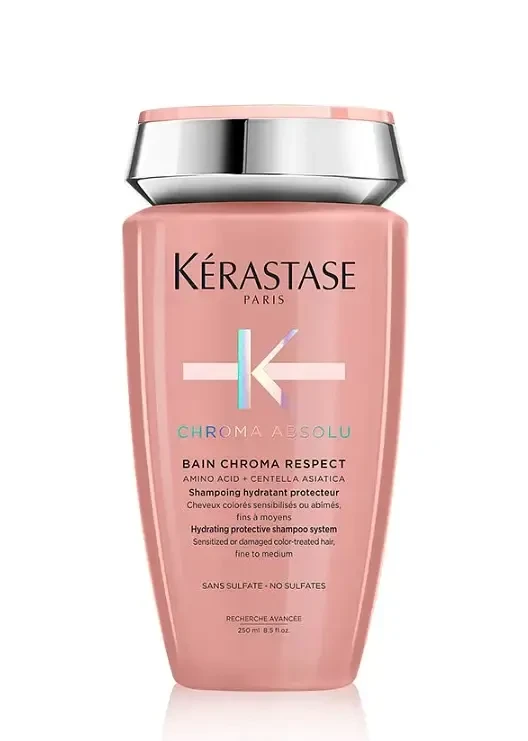
Kérastase Bain Chroma Respect Shampoo by Kérastase
Kérastase

Kérastase Bain Chroma Respect Shampoo

Shampooshair care

Safety score

Pregnancy-focused assessment

Low Risk74/100
Higher concernLower concern

One or more ingredients have a low-risk flag in MamaSkin's current assessment. Review the notes and your own circumstances.

Formula and assessment check

Ingredient safety review updated 9 December 2025. Product formulas can change, so compare the ingredients shown here with the packaging you have.

Report a formula mismatch

MamaSkin assessment · 9 December 2025

Is Kérastase Bain Chroma Respect Shampoo suitable during pregnancy?

MamaSkin currently classifies Kérastase Bain Chroma Respect Shampoo as Low risk, with a stored score of 74/100. This is a precautionary classification, not an unqualified pregnancy-safe recommendation. Read the ingredient context and any manual-review explanation below.

What does the ingredient evidence show?

The recorded formula includes 3 ingredient entries with risk flags: Salicylic Acid (Low risk), Lactic Acid (Low risk), Parfum (Low risk). These are ingredient-level flags; they do not replace the stored product assessment or account for every formulation detail.

30 of 30 ingredient entries on this page have a recorded score, evidence summary and source text. That describes documentation coverage, not proof that the finished formula has been clinically tested during pregnancy.

Ingredient breakdown

See how the listed formula falls across MamaSkin's pregnancy-focused risk bands.

27

No known risks

3

Low risk

0

Medium risk

0

High risk

Ingredients

Ingredients with a higher risk flag appear first, followed by the rest of the formula.

Parfum

Low Risk

Umbrella term for an undisclosed fragrance blend. It’s not usually a pregnancy-specific concern at normal cosmetic use levels, but the exact components and concentrations aren’t fully disclosed on the label, so we score it more conservatively. If you prefer maximum transparency (or you’re sensitive to fragrance compounds), choose fragrance-free/unscented products.

Sources: SCCS: Fragrance allergens in cosmetic products https://health.ec.europa.eu/latest-updates/sccs-new-opinion-fragrance-allergens-cosmetic-products-2012-07-31_en
Salicylic Acid

Low Risk

Salicylic acid is a beta-hydroxy acid used for exfoliation and as a preservative. Exposure depends on concentration, product category, treated area, frequency, skin condition and inhalation or oral potential. Current SCCS assessments support specified cosmetic uses and restrictions; ordinary limited-area low-strength topical use is not equivalent to a professional peel, large-area leave-on treatment or oral salicylate exposure. MamaSkin retains Low Risk with those route and exposure qualifications.

Sources: SCCS/1646/22: Final Opinion on Salicylic Acid https://health.ec.europa.eu/latest-updates/sccs-final-opinion-salicylic-acid-2023-06-09_en; SCCS follow-up on children's exposure https://health.ec.europa.eu/publications/sccs-opinion-salicylic-acid-cas-no-69-72-7-ec-no-200-712-3-childrens-exposure_en

Lactic Acid

Low Risk

Endogenous alpha-hydroxy acid and humectant; at modest cosmetic concentrations (≈5% and below, and generally <10%) topical lactic acid is considered compatible with pregnancy. Main risks are local irritation and increased photosensitivity rather than systemic toxicity or fetal effects.

Sources: MotherToBaby: Topical acne treatments in pregnancy and breastfeeding https://www.ncbi.nlm.nih.gov/books/NBK582985/

Show all (30)

Water

No Known Risks

Water (Aqua) is the standard purified water used as a cosmetic solvent. It has no pregnancy-specific risk in normal topical use.

Sources: https://pubchem.ncbi.nlm.nih.gov/compound/Water, https://single-market-economy.ec.europa.eu/sectors/cosmetics/cosmetic-ingredient-database/cosing-glossary-ingredients_en

Sodium C14-16 Olefin Sulfonate

No Known Risks

An anionic surfactant used mainly to cleanse and create foam in shampoos, washes and facial cleansers. Cosmetic safety reviewers concluded that sodium alpha-olefin sulfonates are safe as used in rinse-off products and safe at low concentrations in leave-on products when formulated to be non-irritating. Concentrated surfactant can irritate skin or eyes, but no pregnancy-specific concern was identified for normal use of a correctly formulated finished cosmetic.

Sources: CIR: Final Report on the Safety Assessment of Sodium Alpha-Olefin Sulfonates https://cir-reports.cir-safety.org/view-attachment/?id=7c154447-8e74-ec11-8943-0022482f06a6

Cocamide Mea

No Known Risks

A fatty-acid monoethanolamide used mainly to boost foam, condition hair or control viscosity. CIR concluded that the reviewed ethanolamides, including Cocamide MEA, Cocamide Methyl MEA, Acetamide MEA and related MEA amides, are safe in current cosmetic use when formulated to be non-irritating and should not be used where N-nitroso compounds may form. Available systemic, genotoxicity and cosmetic-exposure evidence did not identify a pregnancy-specific concern. This assessment assumes compliant impurity control and is not an assessment of concentrated occupational inhalation exposure.

Sources: CIR: Final Amended Safety Assessment of Ethanolamides https://www.cir-safety.org/sites/default/files/amides032012FAR.pdf; CIR: Cocamide MEA ingredient review https://www.cir-safety.org/ingredient/cocamide-mea; European Commission CosIng and EU cosmetics restrictions concerning nitrosamine formation.

Glycerin

No Known Risks

Glycerin is a widely used humectant that supports hydration and the skin barrier, with a long safety record and no known pregnancy or breastfeeding concerns in topical cosmetic use.

Sources: CIR; EU/UK Cosmetics Regulation

Cocamidopropyl Betaine

No Known Risks

Mild amphoteric surfactant used in cleansers and shampoos to boost foam and reduce harshness. Reviewed cosmetic safety sources support present cosmetic use, with no pregnancy- or breastfeeding-specific topical signal identified; the main practical caveat is irritation or allergy in some users, sometimes linked to sensitising impurities.

Sources: CIR: Safety Assessment of Cocamidopropyl Betaine and Related Amidopropyl Betaines as Used in Cosmetics; EU CosIng / cosmetics regulatory inventory

Glycol Distearate

No Known Risks

A fatty-acid ester used for opacifying, emolliency and texture. Cosmetic safety reviewers concluded that glycol distearate is safe as used; available cosmetic exposure does not identify a pregnancy- or breastfeeding-specific concern.

Sources: CIR: Safety Assessment of Monoalkylglycol Dialkyl Acid Esters https://www.cir-safety.org/sites/default/files/glycol%20esters.pdf; CIR ingredient record: Glycol Distearate https://cir-safety.org/ingredient/glycol-distearate

Sodium Lauroyl Sarcosinate

No Known Risks

An anionic cleansing surfactant. Cosmetic safety reviewers concluded that sodium lauroyl sarcosinate is safe in rinse-off cosmetics and in leave-on products up to 5%, provided it is not used in ways that promote nitrosamine formation or inhalation. No pregnancy-specific concern was identified under those conditions.

Sources: CIR: Final Report on the Safety Assessment of Cocoyl Sarcosine and Related Sarcosinates https://cir-reports.cir-safety.org/view-attachment?id=915a3c2f-8e74-ec11-8943-0022482f06a6

Hexylene Glycol

No Known Risks

Solvent and humectant used to improve texture and ingredient solubility in topical cosmetics. Reviewed cosmetic ingredient references do not identify a pregnancy- or breastfeeding-specific concern for normal topical use.

Sources: CIR cosmetic ingredient safety references for alkane diols/glycols; EU CosIng / cosmetics regulatory inventory

Citric Acid

No Known Risks

pH adjuster used in small amounts to maintain product stability. Not associated with pregnancy-specific concerns.

Sources: Scientific Committee on Consumer Safety (EU); European cosmetics regulatory framework

Sodium Hydroxide

No Known Risks

pH adjuster used in very small quantities to balance formulations. Not associated with pregnancy-specific concerns.

Sources: Scientific Committee on Consumer Safety (EU); European cosmetics regulatory framework

Sodium Chloride

No Known Risks

Sodium chloride is used to adjust viscosity and texture in formulations; topical cosmetic use is considered low concern with no known pregnancy or breastfeeding risks.

Sources: CIR; EU/UK Cosmetics Regulation

PEG-55 Propylene Glycol Oleate

No Known Risks

An ethoxylated propylene-glycol fatty-acid ester used as a surfactant or emollient. CIR reviewed PEG-55 Propylene Glycol Oleate within the PEG propylene-glycol derivative family and concluded the assessed ingredients are safe as used when formulated to be non-irritating. Ethoxylation impurity controls apply; no pregnancy-specific topical concern was identified.

Sources: CIR ingredient record: PEG-55 Propylene Glycol Oleate https://www.cir-safety.org/ingredient/peg-55-propylene-glycol-oleate; CIR safety assessment of PEG propylene glycol derivatives

Propylene Glycol

No Known Risks

Propylene glycol is a common solvent and humectant with a long history of use; it is not considered a pregnancy or breastfeeding concern in topical cosmetics, though some individuals may experience irritation in leave-on products.

Sources: CIR; EU/UK Cosmetics Regulation

Coco-Betaine

No Known Risks

A cleansing and foam-supporting surfactant made from coconut-derived fatty chains. Cosmetic safety reviewers concluded that alkyl betaines, including coco-betaine, are safe in current practices when formulated to be non-irritating. Surfactant-containing products may still sting eyes or irritated skin.

Sources: CIR: Quick Reference Table conclusion for Coco-Betaine and alkyl betaines https://www.cir-safety.org/sites/default/files/sq-fix_2.pdf

Sodium Benzoate

No Known Risks

Preservative widely used in foods and cosmetics. Considered safe at regulated concentrations with low systemic exposure from topical use.

Sources: Scientific Committee on Consumer Safety (EU); European cosmetics regulatory framework

Hydroxypropyl Guar Hydroxypropyltrimonium Chloride

No Known Risks

A cationic guar polymer used for hair and skin conditioning. Cosmetic safety reviewers concluded that the assessed guar hydroxypropyltrimonium ingredients are safe in current practices. Absorption of the intact polymer is expected to be limited.

Sources: CIR: Guar Hydroxypropyltrimonium ingredients conclusion, IJT 34(Suppl. 1), 2015; December 2025 Quick Reference Table https://cir-safety.org/sites/default/files/QRT-Update-Dec2025.pdf

Carbomer

No Known Risks

Polymer thickener used to create gel textures. Large-molecule ingredient with negligible systemic absorption.

Sources: Cosmetic Ingredient Review (US); Scientific Committee on Consumer Safety (EU)

Benzoic Acid

No Known Risks

Preservative acid used to help control microbial growth and support formula stability. Reviewed cosmetic safety sources support current cosmetic use, with no pregnancy- or breastfeeding-specific topical concern identified in the material reviewed; some users may still notice local irritation or stinging, especially on compromised skin.

Sources: CIR: Safety Assessment of Benzoic Acid and Sodium Benzoate as Used in Cosmetics; EU CosIng / cosmetics regulatory inventory

Polyquaternium-7

No Known Risks

A large conditioning and film-forming polymer used mainly in hair and cleansing products. Cosmetic safety reviewers concluded that Polyquaternium-7 is safe in current cosmetic use at the reviewed concentrations. Its polymeric nature limits systemic exposure, and no pregnancy-specific concern is identified for normal topical use.

Sources: CIR: Safety Assessment of Polyquaternium-7, cited in the CIR Quick Reference Table https://www.cir-safety.org/sites/default/files/safe-092017posted122017.pdf

Linalool

No Known Risks

Linalool is a common fragrance component used at low levels in cosmetics; it is not a pregnancy-specific concern in topical use, but it is a recognised fragrance allergen and may trigger irritation or sensitisation in some people, especially if the product oxidises over time.

Sources: EU/UK cosmetics (fragrance allergen labelling); IFRA; toxicology reviews

Limonene

No Known Risks

Limonene is a common fragrance component used at low levels in cosmetics; it is not a pregnancy-specific concern in topical use, but it is a recognised fragrance allergen and may trigger irritation or sensitisation in some people, especially if the product oxidises over time.

Sources: EU/UK cosmetics (fragrance allergen labelling); IFRA; toxicology reviews

Sodium Hyaluronate

No Known Risks

Sodium hyaluronate (hyaluronic acid salt) is used for hydration and cushioning, with very low systemic absorption from topical use and no known pregnancy or breastfeeding concerns at cosmetic concentrations.

Sources: CIR; EU/UK Cosmetics Regulation

Arginine

No Known Risks

Amino acid used as a humectant, skin-conditioning agent, and pH-adjusting support ingredient. Reviewed cosmetic safety sources support normal topical use, with no pregnancy- or breastfeeding-specific topical signal identified in the material reviewed.

Sources: CIR: Safety Assessment of α-Amino Acids as Used in Cosmetics; EU CosIng / cosmetics regulatory inventory

Centella Asiatica Extract

No Known Risks

Botanical skin-conditioning ingredient used in soothing and barrier-support formulas. Reviewed cosmetic safety sources support current cosmetic use when formulated to be non-sensitising, with no pregnancy- or breastfeeding-specific topical concern identified in the material reviewed.

Sources: CIR: Safety Assessment of Centella asiatica-derived Ingredients as Used in Cosmetics; EU CosIng / cosmetics regulatory inventory

CI 17200

No Known Risks

Also known as D&C Red No. 33, this certified colour additive is used in cosmetics subject to product-area, concentration, identity, purity and batch-certification requirements. FDA permits specified cosmetic uses but not every route or application area. No pregnancy-specific concern is identified for normal use in a compliant finished cosmetic.

Sources: FDA: Color Additives Permitted for Use in Cosmetics, including D&C Red No. 33 https://www.fda.gov/cosmetics/cosmetic-ingredient-names/color-additives-permitted-use-cosmetics; FDA: Color Additives and Cosmetics Fact Sheet https://www.fda.gov/industry/color-additives/color-additives-and-cosmetics-fact-sheet

CI 19140

No Known Risks

Also known as FD&C Yellow No. 5 or tartrazine, this certified colour additive is used in cosmetics and other regulated products. FDA permits its use in cosmetics, including the eye area, when identity, purity, certification and use requirements are met. Rare allergy-like reactions can occur, but no pregnancy-specific concern is identified for normal use in a compliant finished cosmetic.

Sources: FDA: Regulatory Status of FD&C Yellow No. 5 / C.I. 19140 https://www.hfpappexternal.fda.gov/scripts/fdcc/index.cfm?id=FDCYellow5&set=ColorAdditives; FDA: Color Additives and Cosmetics Fact Sheet https://www.fda.gov/industry/color-additives/color-additives-and-cosmetics-fact-sheet

Ceramide AP

No Known Risks

Skin-identical barrier lipid used to support barrier function and reduce dryness. Reviewed cosmetic safety sources support normal topical use, with no pregnancy- or breastfeeding-specific topical signal identified in the material reviewed.

Sources: CIR: Safety Assessment of Ceramides as Used in Cosmetics; EU CosIng / cosmetics regulatory inventory

Formulations can change without notice. For the most accurate result, compare this list with your packaging and scan the exact ingredient label in MamaSkin when you repurchase.

Questions about this assessment

Has every ingredient in Kérastase Bain Chroma Respect Shampoo been assessed?

30 of 30 ingredient entries on this page have a recorded score, evidence summary and source text. That describes documentation coverage, not proof that the finished formula has been clinically tested during pregnancy.

Does this assessment apply to the Kérastase Bain Chroma Respect Shampoo I have?

Only if the ingredient list on your packaging matches the recorded formula shown here. Formulas can differ by market and change over time. Compare the full list, not just the product name; report a mismatch if it differs.

Does this pregnancy assessment also establish breastfeeding suitability?

No. This page presents a pregnancy-focused product assessment. Do not infer a breastfeeding conclusion from its score or label; breastfeeding requires a separate assessment of the formula and how it is used.

How to use this assessment

The risk band is the primary conclusion. The score adds detail within that band and should not be used to compare products as if a one-point difference were clinically meaningful.

MamaSkin provides pregnancy-focused information, not medical advice. Your midwife, GP, pharmacist or dermatologist should take priority when your circumstances differ from typical cosmetic use.

Read the full methodology