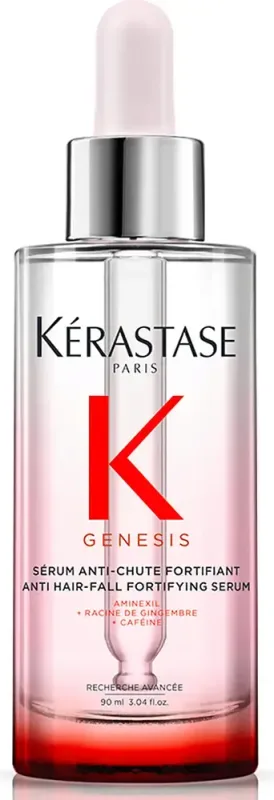
Kérastase Genesis Anti Hair-Fall Fortifying Serum by Kérastase
Kérastase

Kérastase Genesis Anti Hair-Fall Fortifying Serum

Hair Serumsserums

Safety score

Pregnancy-focused assessment

Medium Risk57/100
Higher concernLower concern

This formula contains an ingredient that needs extra caution in MamaSkin's pregnancy-focused assessment.

Formula and assessment check

Ingredient safety review updated 15 February 2026. Product formulas can change, so compare the ingredients shown here with the packaging you have.

Report a formula mismatch

Ingredient breakdown

See how the listed formula falls across MamaSkin's pregnancy-focused risk bands.

26

No known risks

2

Low risk

2

Medium risk

0

High risk

Ingredients

Ingredients with a higher risk flag appear first, followed by the rest of the formula.

Benzyl Salicylate

Medium Risk

Benzyl salicylate is a fragrance ingredient that is also evaluated for potential endocrine activity and sensitisation. SCCS notes some indications for endocrine mode of action, and fragrance allergens are relevant for contact allergy risk; pregnancy-specific human outcome data for topical exposure are limited. The medium-risk signal is endocrine-related uncertainty and sensitisation potential rather than a defined pregnancy-specific toxicity dataset.

Sources: EU SCCS Final Opinion on Benzyl Salicylate (SCCS/1656/23; sccs_o_277.pdf, 2023); EU fragrance allergen labelling framework (EU Cosmetics Regulation).

BHT

Medium Risk

BHT (butylated hydroxytoluene) is a lipophilic antioxidant used to protect oils from oxidation. Animal studies at high (primarily oral) doses show liver enzyme induction and related biochemical changes; endocrine-screening lines of evidence have also been evaluated in regulatory reviews. Pregnancy-specific human outcome data for topical cosmetic exposure are limited; the key signal is systemic toxicology at higher exposures and uncertainty for pregnancy-specific outcomes.

Sources: EU SCCS Opinion on BHT (SCCS/1636/21; sccs_o_257.pdf, 2021); CIR: Safety Assessment of BHT as used in cosmetics.

Parfum

Low Risk

Umbrella term for an undisclosed fragrance blend. It’s not usually a pregnancy-specific concern at normal cosmetic use levels, but the exact components and concentrations aren’t fully disclosed on the label, so we score it more conservatively. If you prefer maximum transparency (or you’re sensitive to fragrance compounds), choose fragrance-free/unscented products.

Sources: EU/UK cosmetics (fragrance allergen labelling); IFRA

Show all (30)

Resveratrol

Low Risk

Resveratrol is a polyphenolic antioxidant used in topical skincare. A high-dose dietary study in pregnant nonhuman primates reported an unexplained alteration in fetal pancreatic development and cautioned against resveratrol supplementation during pregnancy. Topical delivery studies indicate substantially lower and largely skin-localised exposure. MamaSkin therefore applies a precautionary Low Risk classification rather than treating topical cosmetic use like oral supplementation.

Sources: PubMed: Beneficial and cautionary outcomes of resveratrol supplementation in pregnant nonhuman primates https://pubmed.ncbi.nlm.nih.gov/24563374/; PubMed: Topical delivery and skin disposition of resveratrol https://pubmed.ncbi.nlm.nih.gov/28389713/; LactMed: Resveratrol https://www.ncbi.nlm.nih.gov/books/NBK501879/.

Water

No Known Risks

Alcohol Denat.

No Known Risks

Volatile solvent used to improve texture, drying time, and penetration in some formulas. Reviewed cosmetic safety sources support current cosmetic use, with no pregnancy- or breastfeeding-specific topical concern identified in the material reviewed; the main practical issue is dryness, stinging, or barrier disruption in some users.

Sources: CIR: Safety Assessment of SD Alcohol 40, Benzyl Alcohol, and Denatured Alcohol in Cosmetic Products; EU CosIng / cosmetics regulatory inventory

Diaminopyrimidine Oxide

No Known Risks

Ammonium Polyacryloyldimethyl Taurate

No Known Risks

A high-molecular-weight polymer used to thicken and stabilise formulas. Cosmetic safety reviewers concluded that acryloyldimethyltaurate polymers are safe in current cosmetic practices. Absorption of the finished polymer is expected to be limited, with residual monomers controlled during manufacture.

Sources: CIR: Safety Assessment of Acryloyldimethyltaurate Polymers as Used in Cosmetics; final report April 2017 https://cir-safety.org/sites/default/files/QRT-Update-Dec2025.pdf

Aminomethyl Propanol

No Known Risks

An alkanolamine used mainly to adjust product pH. Cosmetic safety reviewers concluded that aminomethyl propanol is safe in current cosmetic use at the reviewed concentrations. Formulators should control secondary-amine impurities and should not combine it with nitrosating agents. No pregnancy-specific concern is identified for normal use of a properly formulated finished cosmetic.

Sources: CIR: Final Amended Report on the Safety Assessment of Aminomethyl Propanol and Aminomethyl Propanediol https://cir-reports.cir-safety.org/view-attachment/?id=62ee6359-8e74-ec11-8943-0022482f06a6

Citric Acid

No Known Risks

pH adjuster used in small amounts to maintain product stability. Not associated with pregnancy-specific concerns.

Sources: Scientific Committee on Consumer Safety (EU); European cosmetics regulatory framework

PEG-40 Hydrogenated Castor Oil

No Known Risks

Solubilizer and emulsifier used to disperse oils and fragrance components in cosmetic formulas. Reviewed cosmetic safety sources support normal topical use, with no pregnancy- or breastfeeding-specific concern identified.

Sources: CIR cosmetic ingredient safety references for PEG castor oil derivatives; EU CosIng / cosmetics regulatory inventory

Piroctone Olamine

No Known Risks

Piroctone Olamine is an antimicrobial and anti-dandruff ingredient. European scientific review supports restricted cosmetic use in rinse-off and other products at specified concentrations. No pregnancy- or breastfeeding-specific hazard was identified for normal topical use within those restrictions.

Sources: EU SCCNFP: Opinion concerning Piroctone Olamine https://ec.europa.eu/health/ph_risk/committees/sccp/documents/out162_en.pdf; EU Cosmetics Regulation Annex V; European Commission CosIng ingredient inventory.

Caffeine

No Known Risks

Methylxanthine used in cosmetics (e.g., de-puffing/firming and antioxidant support). No pregnancy-specific contraindications are identified for topical cosmetic use.

Sources: CIR (Methylxanthines); PubMed (NLM)

Arginine

No Known Risks

Amino acid used as a humectant, skin-conditioning agent, and pH-adjusting support ingredient. Reviewed cosmetic safety sources support normal topical use, with no pregnancy- or breastfeeding-specific topical signal identified in the material reviewed.

Sources: CIR: Safety Assessment of α-Amino Acids as Used in Cosmetics; EU CosIng / cosmetics regulatory inventory

Limonene

No Known Risks

Limonene is a common fragrance component used at low levels in cosmetics; it is not a pregnancy-specific concern in topical use, but it is a recognised fragrance allergen and may trigger irritation or sensitisation in some people, especially if the product oxidises over time.

Sources: EU/UK cosmetics (fragrance allergen labelling); IFRA; toxicology reviews

Niacinamide

No Known Risks

Niacinamide (vitamin B3) is widely used for barrier support and tone/texture benefits, and is generally considered safe in pregnancy and breastfeeding when used topically at cosmetic concentrations.

Sources: CIR; EU/UK Cosmetics Regulation

Pyridoxine Hcl

No Known Risks

A vitamin B ingredient or derivative used for skin or hair conditioning. These vitamins are normal nutrients and no pregnancy-specific concern was identified for the small topical exposure expected from a finished cosmetic. This assessment does not replace guidance about oral supplements or therapeutic doses.

Sources: NIH Office of Dietary Supplements vitamin fact sheets https://ods.od.nih.gov/factsheets/list-all/; CIR: Panthenol, Pantothenic Acid and Derivatives safety assessment https://www.cir-safety.org/supplementaldoc/safety-assessment-panthenol-pantothenic-acid-and-derivatives-used-cosmetics-1

Linalool

No Known Risks

Linalool is a common fragrance component used at low levels in cosmetics; it is not a pregnancy-specific concern in topical use, but it is a recognised fragrance allergen and may trigger irritation or sensitisation in some people, especially if the product oxidises over time.

Sources: EU/UK cosmetics (fragrance allergen labelling); IFRA; toxicology reviews

Safflower Glucoside

No Known Risks

Coumarin

No Known Risks

An aromatic fragrance ingredient found naturally in some plants and also manufactured. It is subject to fragrance-allergen labelling because it can sensitise susceptible users; no pregnancy-specific concern is identified for normal topical cosmetic use.

Sources: European Commission: Fragrance allergens labelling https://single-market-economy.ec.europa.eu/sectors/cosmetics/cosmetic-products-specific-topics/fragrance-allergens-labelling_en; SCCS fragrance-allergen opinions

Citral

No Known Risks

A lemon-scented mixture of the aldehydes geranial and neral used in fragrance. Citral is a recognised skin sensitiser, but current cosmetic concerns relate to allergy and concentration rather than a pregnancy-specific hazard from normal topical use.

Sources: European Commission: Fragrance allergens labelling https://single-market-economy.ec.europa.eu/sectors/cosmetics/cosmetic-products-specific-topics/fragrance-allergens-labelling_en; SCCS fragrance-allergen opinions

Benzyl Alcohol

No Known Risks

Benzyl alcohol is used as a preservative and fragrance component in cosmetics; it is not a pregnancy-specific concern at typical topical exposure, but it can be irritating or sensitising for some individuals, particularly in leave-on products.

Sources: CIR; EU/UK Cosmetics Regulation; toxicology reviews

Xylitylglucoside

No Known Risks

A sugar-derived humectant commonly used with xylitol and anhydroxylitol to support skin hydration. Exact pregnancy-specific topical data are limited. Cosmetic safety assessments of the related saccharide mixture and xylitol did not identify a reproductive or pregnancy-specific concern at cosmetic exposure; available data primarily support local tolerance rather than proving pregnancy safety. No topical contraindication was identified in the reviewed material.

Sources: CIR: Safety Assessment of Saccharide Isomerate and Related Saccharides https://cir-safety.org/supplementaldoc/safety-assessment-anhydrogalactose-anhydroglucitol-anhydroxylitol-arabinose-psicose-; CIR: Safety Assessment of Mannitol, Sorbitol, and Xylitol https://www.cir-safety.org/sites/default/files/xylito122019FR.pdf

Citronellol

No Known Risks

A rose-like fragrance ingredient that occurs naturally in many essential oils and may also be manufactured. Its main cosmetic concern is contact allergy in susceptible users; no pregnancy-specific hazard is identified for normal topical cosmetic exposure.

Sources: European Commission: Fragrance allergens labelling https://single-market-economy.ec.europa.eu/sectors/cosmetics/cosmetic-products-specific-topics/fragrance-allergens-labelling_en; SCCS fragrance-allergen opinions

Benzyl Benzoate

No Known Risks

A fragrance ingredient, solvent and fixative that also occurs naturally in some essential oils. It is a labelled fragrance allergen and may irritate or sensitise susceptible users, but no pregnancy-specific concern is identified for normal topical cosmetic exposure.

Sources: European Commission: Fragrance allergens labelling https://single-market-economy.ec.europa.eu/sectors/cosmetics/cosmetic-products-specific-topics/fragrance-allergens-labelling_en; SCCS fragrance-allergen opinions

Anhydroxylitol

No Known Risks

Sugar-derived humectant used to support hydration, often as part of saccharide blends. Reviewed cosmetic safety sources support normal topical use, with no pregnancy- or breastfeeding-specific topical signal identified in the material reviewed.

Sources: CIR: Safety Assessment of Saccharide Humectants / Saccharide Isomerate, etc.; EU CosIng / cosmetics regulatory inventory

Xylitol

No Known Risks

Sugar alcohol humectant used to help maintain hydration and improve skin feel. Reviewed cosmetic safety sources support normal topical use, with no pregnancy- or breastfeeding-specific topical signal identified in the material reviewed.

Sources: CIR: Safety Assessment of Mannitol, Sorbitol, and Xylitol as Used in Cosmetics; EU CosIng / cosmetics regulatory inventory

Zingiber Officinale Root Extract

No Known Risks

A ginger root extract used mainly for skin conditioning and fragrance support. Cosmetic safety reviewers concluded that the assessed Zingiber officinale root-derived ingredients are safe in current practices when formulated to be non-sensitising. This topical cosmetic conclusion should not be read as advice about ingesting concentrated ginger supplements.

Sources: CIR: Safety Assessment of Zingiber officinale (Ginger)-Derived Ingredients as Used in Cosmetics https://www.cir-safety.org/supplementaldoc/safety-assessment-zingiber-officinale-ginger-%E2%80%93-derived-ingredients-used-cosmetics-0

Tocopherol

No Known Risks

Vitamin E antioxidant used to protect oils and support the skin barrier. Not associated with pregnancy-specific concerns at cosmetic exposure.

Sources: Cosmetic Ingredient Review (US); Scientific Committee on Consumer Safety (EU)

Sodium Citrate

No Known Risks

Buffering and chelating ingredient used to control pH and formulation stability. Reviewed cosmetic safety sources support normal topical use, with no pregnancy- or breastfeeding-specific topical signal identified in the material reviewed.

Sources: CIR: Safety Assessment of Citric Acid, Inorganic Citrate Salts, and Alkyl Citrate Esters as Used in Cosmetics; EU CosIng / cosmetics regulatory inventory

Formulations can change without notice. For the most accurate result, compare this list with your packaging and scan the exact ingredient label in MamaSkin when you repurchase.

How to use this assessment

The risk band is the primary conclusion. The score adds detail within that band and should not be used to compare products as if a one-point difference were clinically meaningful.

MamaSkin provides pregnancy-focused information, not medical advice. Your midwife, GP, pharmacist or dermatologist should take priority when your circumstances differ from typical cosmetic use.

Read the full methodology