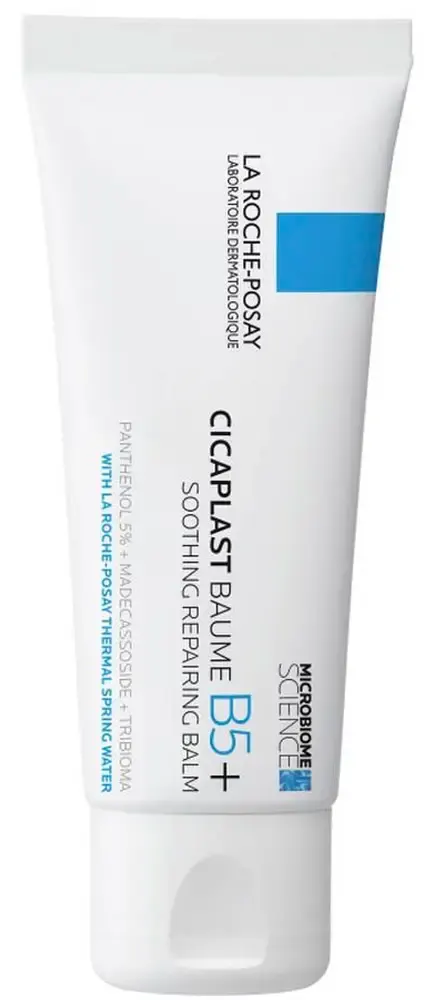
La Roche-Posay Cicaplast Baume B5+ by La Roche-Posay
La Roche-Posay

La Roche-Posay Cicaplast Baume B5+

General Moisturizersmoisturisers

Safety score

Pregnancy-focused assessment

Low Risk79/100
Higher concernLower concern

One or more ingredients have a low-risk flag in MamaSkin's current assessment. Review the notes and your own circumstances.

Ingredient safety review updated 15 February 2026.

Check the current formula in MamaSkin

Copy the product name, download MamaSkin and search it for free. You can also scan the ingredient label on the product you own.

Download MamaSkin on the App StoreGet MamaSkin on Google Play

Ingredient breakdown

See how the listed formula falls across MamaSkin's pregnancy-focused risk bands.

32

No known risks

1

Low risk

0

Medium risk

0

High risk

Ingredients

Ingredients with a higher risk flag appear first, followed by the rest of the formula.

Dimethicone

Low Risk

Dimethicone is a silicone polymer used as a skin protectant and slip/conditioning agent. It is considered inert with minimal dermal absorption; the main practical issues are cosmetic (feel) and occasional irritation in very sensitive users. It is not a pregnancy-specific concern in topical cosmetic use.

Sources: CIR: Safety Assessment of Dimethicone, Methicone, and related ingredients as used in cosmetics (Methicones report; 2019/2022 update); EU CosIng entry for Dimethicone.

Water

No Known Risks

Hydrogenated Polyisobutene

No Known Risks

Inert synthetic emollient used as a glossing and occlusive agent. Reviewed cosmetic safety sources support normal topical use, with no pregnancy- or breastfeeding-specific topical signal identified in the material reviewed.

Sources: CIR: Safety Assessment of Polyene Group as Used in Cosmetics; EU CosIng / cosmetics regulatory inventory

Show all (33)

Glycerin

No Known Risks

Glycerin is a widely used humectant that supports hydration and the skin barrier, with a long safety record and no known pregnancy or breastfeeding concerns in topical cosmetic use.

Sources: CIR; EU/UK Cosmetics Regulation

Butyrospermum Parkii Butter

No Known Risks

Butyrospermum parkii (shea) butter is an emollient/occlusive that supports the skin barrier; topical use is considered low concern with no known pregnancy or breastfeeding risks.

Sources: CIR; EU/UK Cosmetics Regulation

Panthenol

No Known Risks

Panthenol (pro-vitamin B5) is used for soothing and barrier support and is generally well tolerated, with no known pregnancy or breastfeeding concerns in topical cosmetic use.

Sources: CIR; EU/UK Cosmetics Regulation

Zea Mays Starch

No Known Risks

Corn starch, a plant-derived polysaccharide used to absorb moisture, reduce greasiness and improve texture. Cosmetic safety reviewers concluded that ingredients derived from Zea mays, including corn starch, are safe in current cosmetic use. No pregnancy-specific concern is identified for normal topical exposure; avoid deliberately inhaling loose powder.

Sources: CIR ingredient review: Zea mays (Corn) Starch https://www.cir-safety.org/ingredient/zea-mays-corn-starch

Propanediol

No Known Risks

Solvent and humectant used to improve texture and ingredient solubility. Low systemic exposure expected from topical cosmetic use.

Sources: Cosmetic Ingredient Review (US); Scientific Committee on Consumer Safety (EU)

Butylene Glycol

No Known Risks

Solvent and humectant commonly used in leave-on products. Not associated with pregnancy-specific concerns at cosmetic exposure levels.

Sources: Cosmetic Ingredient Review (US); Scientific Committee on Consumer Safety (EU)

Cetyl PEG/PPG-10/1 Dimethicone

No Known Risks

A silicone polyether used mainly as an emulsifier and conditioning ingredient. The Cosmetic Ingredient Review concluded that this ingredient is safe in current cosmetic use. Concentrated-material tests found limited transient irritation, while a finished cosmetic containing 15% was non-irritating in human patch testing; no pregnancy- or breastfeeding-specific concern is identified for normal topical use.

Sources: CIR: Safety Assessment of Polyoxyalkylene Siloxane Copolymers as Used in Cosmetics (Final Report 2014) https://cir-safety.org/sites/default/files/ROPSIL_122014%20_FAR.pdf

Trihydroxystearin

No Known Risks

A triglyceride-derived thickener and suspending agent. Cosmetic safety reviewers concluded that trihydroxystearin is safe as used; the assessment found low acute toxicity, no mutagenicity and little skin irritation in the reviewed tests. No pregnancy-specific concern was identified for normal topical exposure.

Sources: CIR: Final Report on the Safety Assessment of Trihydroxystearin, International Journal of Toxicology 19(Suppl. 2):89-94, 2000; CIR ingredient record https://www.cir-safety.org/ingredient/trihydroxystearin

Centella Asiatica Leaf Extract

No Known Risks

A leaf extract used in soothing and skin-conditioning formulas. Cosmetic safety reviewers concluded that Centella asiatica leaf extract is safe at current cosmetic exposure when products are formulated to be non-sensitising. The assessment considered systemic and reproductive findings reported at substantially higher oral exposures; these did not establish a pregnancy-specific concern for ordinary topical cosmetic use. Centella constituents can still cause contact sensitivity in some people.

Sources: CIR: Safety Assessment of Centella asiatica-Derived Ingredients as Used in Cosmetics https://cir-safety.org/supplementaldoc/safety-assessment-centella-asiatica-derived-ingredients-used-cosmetics-1

Polymnia Sonchifolia Root Juice

No Known Risks

Zinc Gluconate

No Known Risks

A mineral salt of gluconic acid used for skin conditioning or formula support. Cosmetic safety reviewers concluded that the assessed gluconate salts are safe in current practices when formulated to be non-irritating.

Sources: CIR: Zinc Gluconate final assessment, March 2018; Copper Gluconate final assessment, March 2025; December 2025 Quick Reference Table https://cir-safety.org/sites/default/files/QRT-Update-Dec2025.pdf

Madecassoside

No Known Risks

A triterpene glycoside associated with Centella asiatica and used in soothing and skin-conditioning formulas. Pregnancy-specific evidence for isolated topical madecassoside is limited. Cosmetic safety reviewers considered Centella-derived ingredients acceptable at current cosmetic exposure but noted that madecassoside and related triterpenes may contribute to sensitisation, so products should be formulated to avoid sensitising concentrations. No pregnancy-specific topical contraindication was identified in the reviewed material.

Sources: CIR: Safety Assessment of Centella asiatica-Derived Ingredients as Used in Cosmetics https://cir-safety.org/supplementaldoc/safety-assessment-centella-asiatica-derived-ingredients-used-cosmetics-1

Manganese Gluconate

No Known Risks

Alpha-Glucan Oligosaccharide

No Known Risks

Silica

No Known Risks

Mineral absorbent and texture aid used to mattify and improve slip. Reviewed cosmetic safety sources support normal topical cosmetic use; this assessment does not cover deliberate inhalation of loose powder.

Sources: CIR: Safety Assessment of Silica and Silicates as Used in Cosmetics; EU CosIng / cosmetics regulatory inventory

Aluminum Hydroxide

No Known Risks

Mineral opacifier, absorbent and pigment-coating ingredient used in makeup, sunscreens and skin care. Low systemic exposure is expected from normal topical cosmetic use, with no pregnancy- or breastfeeding-specific concern identified in reviewed cosmetic references.

Sources: CIR cosmetic ingredient safety references for alumina/aluminum hydroxide ingredients; EU CosIng / cosmetics regulatory inventory

Magnesium Sulfate

No Known Risks

Inorganic salt used as a viscosity-control, bulking or stabilizing ingredient in cosmetics. Reviewed cosmetic ingredient references do not identify a pregnancy- or breastfeeding-specific concern for normal topical use.

Sources: CIR cosmetic ingredient safety references for inorganic salts; EU CosIng / cosmetics regulatory inventory

Mannose

No Known Risks

Capryloyl Glycine

No Known Risks

An amino-acid-derived surfactant or conditioning ingredient. Cosmetic safety reviewers concluded that amino acid alkyl amides are safe in current cosmetic practices when formulated to be non-irritating. Manufacturing and formulation should control nitrosamine formation where relevant.

Sources: CIR: Safety Assessment of Amino Acid Alkyl Amides as Used in Cosmetics https://www.cir-safety.org/supplementaldoc/safety-assessment-amino-acid-alkyl-amides-used-cosmetics-0

Caprylyl Glycol

No Known Risks

Humectant and preservative booster used to support product stability. Low systemic exposure expected from topical cosmetic use.

Sources: Scientific Committee on Consumer Safety (EU); Cosmetic Ingredient Review (US)

Vitreoscilla Ferment

No Known Risks

Citric Acid

No Known Risks

pH adjuster used in small amounts to maintain product stability. Not associated with pregnancy-specific concerns.

Sources: Scientific Committee on Consumer Safety (EU); European cosmetics regulatory framework

Trisodium Ethylenediamine Disuccinate

No Known Risks

Chelating ingredient used to improve formula stability by binding trace metals. Reviewed cosmetic ingredient references do not identify a pregnancy- or breastfeeding-specific concern for normal topical use.

Sources: CIR cosmetic ingredient safety references for chelating agents; EU CosIng / cosmetics regulatory inventory

Lactobacillus

No Known Risks

Acetylated Glycol Stearate

No Known Risks

Maltodextrin

No Known Risks

Polysaccharide carrier and bulking agent used for texture and delivery support. Reviewed cosmetic safety sources support normal topical use, with no pregnancy- or breastfeeding-specific topical signal identified in the material reviewed.

Sources: CIR: Safety Assessment of Polysaccharide Gums as Used in Cosmetics; EU CosIng / cosmetics regulatory inventory

Polyglyceryl-4 Isostearate

No Known Risks

A polyglycerin fatty-acid ester used as an emulsifier, dispersant or emollient. Cosmetic safety reviewers concluded that the assessed family of 274 polyglyceryl fatty acid esters is safe in current practices when formulated to be non-irritating. No pregnancy-specific concern was identified for normal topical cosmetic exposure.

Sources: CIR: Safety Assessment of Polyglyceryl Fatty Acid Esters as Used in Cosmetics https://www.cir-safety.org/supplementaldoc/safety-assessment-polyglyceryl-fatty-acid-esters-used-cosmetics-1

Tocopherol

No Known Risks

Vitamin E antioxidant used to protect oils and support the skin barrier. Not associated with pregnancy-specific concerns at cosmetic exposure.

Sources: Cosmetic Ingredient Review (US); Scientific Committee on Consumer Safety (EU)

Pentaerythrityl Tetra-Di-T-Butyl Hydroxyhydrocinnamate

No Known Risks

Antioxidant and stabilizer used to protect cosmetic formulas from oxidation. Reviewed cosmetic ingredient references do not identify a pregnancy- or breastfeeding-specific concern for normal topical cosmetic use.

Sources: CIR cosmetic ingredient safety references for hindered phenolic antioxidants; EU CosIng / cosmetics regulatory inventory

Titanium Dioxide

No Known Risks

Inorganic mineral pigment and, in some products, a mineral UV filter. For typical topical use in creams, lotions and makeup, systemic absorption is expected to be very low. Most concerns discussed in the literature relate to ingestion (food additive E171) or inhalation exposure from fine powders/sprays, and to specific nanoparticle characterisation. For routine topical cosmetic use, it is generally considered acceptable in pregnancy and breastfeeding; if you prefer a cautious approach, avoid inhaling loose powders or sprays.

Sources: EFSA opinion on titanium dioxide as food additive E171 (ingestion context); SCCS opinions on titanium dioxide in cosmetics (including inhalation/nano considerations); general dermatology guidance on mineral sunscreens in pregnancy.

Formulations can change without notice. For the most accurate result, compare this list with your packaging and scan the exact ingredient label in MamaSkin when you repurchase.

How to use this assessment

The risk band is the primary conclusion. The score adds detail within that band and should not be used to compare products as if a one-point difference were clinically meaningful.

MamaSkin provides pregnancy-focused information, not medical advice. Your midwife, GP, pharmacist or dermatologist should take priority when your circumstances differ from typical cosmetic use.

Read the full methodology