La Roche-Posay
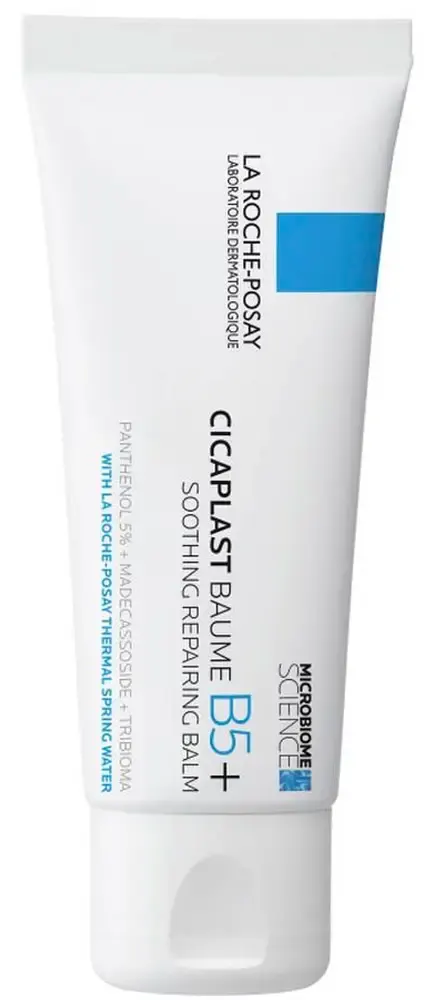
La Roche-Posay Cicaplast Baume B5+
Low risk75/100

Facial Treatments
Higher-risk ingredients are flagged in this formula. Discuss alternatives with your healthcare professional.
8 of 8 ingredients rated
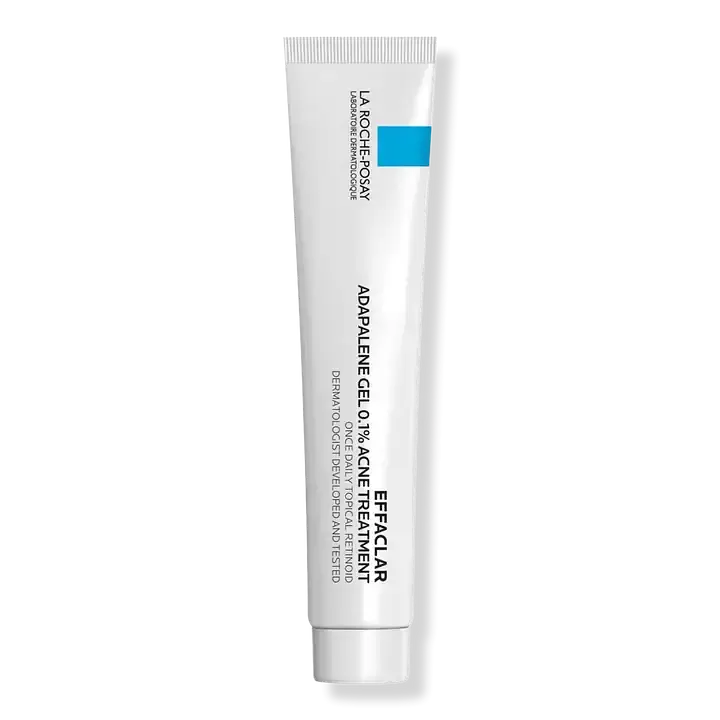
MamaSkin rates the recorded formula for La Roche-Posay Effaclar Adapalene Gel 0.1% Topical Retinoid For Acne as High risk (26/100). This is not a pregnancy-safe recommendation. Discuss alternatives with a qualified healthcare professional.
The recorded formula includes 2 ingredient entries with risk flags: Adapalene 0.1% (High risk), Methylparaben (Medium risk). These are ingredient-level flags; they do not replace the stored product assessment or account for every formulation detail.
8 of 8 ingredient entries on this page have a recorded score, evidence summary and source text. That describes documentation coverage, not proof that the finished formula has been clinically tested during pregnancy.
How we assess productsThe recorded formula, with evidence behind each rating. Unmatched ingredients are marked Not assessed in grey.
Adapalene is a topical retinoid used for acne that acts via retinoid receptors to normalise keratinisation and reduce inflammation. Retinoids are proven teratogens when systemic exposure occurs; for topical adapalene, UKTIS states an increased risk of malformation is unlikely when used as directed, but use in pregnancy cannot be recommended because pregnancy data are inadequate and class teratogenicity is well established. Regulators (EMA/MHRA) also advise topical retinoids should not be used during pregnancy as a precaution.
Sources: EMA: Updated measures for pregnancy prevention during retinoid use https://www.ema.europa.eu/en/news/updated-measures-pregnancy-prevention-during-retinoid-use
Methylparaben is a preservative with weak endocrine activity in some experimental systems. After reviewing the available endocrine and toxicology evidence, SCCS/1652/23 concluded that methylparaben is safe in cosmetics up to 0.4% as acid, including up to 0.4% within permitted ester mixtures whose total does not exceed 0.8%. Pregnancy-specific human outcome data for repeated topical exposure remain limited. MamaSkin retains Medium Risk as a deliberately conservative pregnancy policy, not because SCCS found compliant cosmetic use unsafe.
Sources: SCCS/1652/23: Opinion on Methylparaben, final 14 December 2023 with 2024 corrigendum https://health.ec.europa.eu/publications/methylparaben-cas-no-99-76-3-ec-no-202-785-7_en; CIR: Amended Safety Assessment of Parabens as Used in Cosmetics https://www.cir-safety.org/supplementaldoc/amended-safety-assessment-parabens-used-cosmetics-0
Polymer thickener used to create gel textures. Large-molecule ingredient with negligible systemic absorption.
Sources: Cosmetic Ingredient Review (US); Scientific Committee on Consumer Safety (EU)
Disodium EDTA is a chelating agent used to improve formula stability and performance; it is considered low concern in topical cosmetic use, with no known pregnancy or breastfeeding risks at typical concentrations.
Sources: CIR; EU/UK Cosmetics Regulation
Poloxamer 182: A PEG/PPG block polymer included in the cosmetic-use assessment. Direct reproductive studies were absent; the assessment considered limited skin uptake and exposure evidence. Manufacture should control ethylene oxide, propylene oxide and 1,4-dioxane residues. Findings from intravenous dosing or prolonged inhalation do not establish harm from ordinary topical cosmetic use. No pregnancy-specific harm has been identified for ordinary topical cosmetic use; direct human pregnancy data are limited.
Sources: https://pubmed.ncbi.nlm.nih.gov/18830866/,https://www.cir-safety.org/sites/default/files/QRT-Update-Dec2025.pdf
Propylene glycol is a common solvent and humectant with a long history of use; it is not considered a pregnancy or breastfeeding concern in topical cosmetics, though some individuals may experience irritation in leave-on products.
Sources: CIR; EU/UK Cosmetics Regulation
Water (Aqua) is the standard purified water used as a cosmetic solvent. It has no pregnancy-specific risk in normal topical use.
Sources: https://pubchem.ncbi.nlm.nih.gov/compound/Water, https://single-market-economy.ec.europa.eu/sectors/cosmetics/cosmetic-ingredient-database/cosing-glossary-ingredients_en
pH adjuster used in very small quantities to balance formulations. Not associated with pregnancy-specific concerns.
Sources: Scientific Committee on Consumer Safety (EU); European cosmetics regulatory framework
Adapalene 0.1%, Carbomer, Disodium EDTA, Methylparaben, Poloxamer 182, Propylene Glycol, Water, Sodium Hydroxide
Ingredient ratings refreshed 1 October 2026. Formulas vary by market and can change. Always compare with your packaging.
The recorded formula includes 2 ingredient entries with risk flags: Adapalene 0.1% (High risk), Methylparaben (Medium risk). These are ingredient-level flags; they do not replace the stored product assessment or account for every formulation detail. The product score is a stored assessment, not a clinical safety guarantee.
8 of 8 ingredient entries on this page have a recorded score, evidence summary and source text. That describes documentation coverage, not proof that the finished formula has been clinically tested during pregnancy.
Only if the ingredient list on your packaging matches the recorded formula shown here. Formulas can differ by market and change over time. Compare the full list, not just the product name; report a mismatch if it differs.
No. This page presents a pregnancy-focused product assessment. Do not infer a breastfeeding conclusion from its score or label; breastfeeding requires a separate assessment of the formula and how it is used.