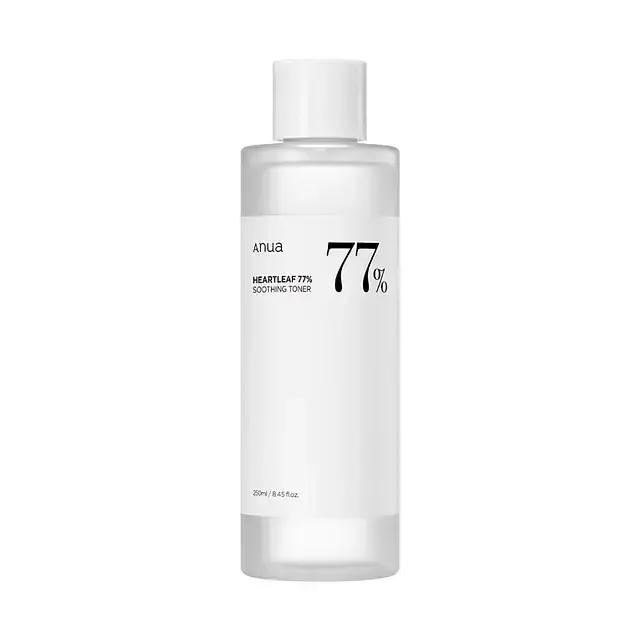
Anua Heartleaf 77% Soothing Toner by Anua
Anua

Anua Heartleaf 77% Soothing Toner

Toners

Safety score

Pregnancy-focused assessment

No Known Risks99/100
Higher concernLower concern

No higher-risk ingredients were identified in MamaSkin's current assessment. Check the latest package before deciding.

Ingredient safety review updated 24 November 2025.

Check the current formula in MamaSkin

Copy the product name, download MamaSkin and search it for free. You can also scan the ingredient label on the product you own.

Download MamaSkin on the App StoreGet MamaSkin on Google Play

Ingredient breakdown

See how the listed formula falls across MamaSkin's pregnancy-focused risk bands.

21

No known risks

0

Low risk

0

Medium risk

0

High risk

Ingredients

Ingredients with a higher risk flag appear first, followed by the rest of the formula.

Houttuynia Cordata Extract 77%

No Known Risks

Water

No Known Risks

1,2-Hexanediol

No Known Risks

1,2-Hexanediol is commonly used as a solvent and preservative booster; topical exposure is low and it has no known pregnancy or breastfeeding concerns at cosmetic concentrations, though very sensitive skin may occasionally react.

Sources: CIR; EU/UK Cosmetics Regulation

Show all (21)

Glycerin

No Known Risks

Glycerin is a widely used humectant that supports hydration and the skin barrier, with a long safety record and no known pregnancy or breastfeeding concerns in topical cosmetic use.

Sources: CIR; EU/UK Cosmetics Regulation

Betaine

No Known Risks

Betaine is a humectant/osmolyte used to support hydration and reduce irritation potential in formulas; it is considered low concern with no known pregnancy or breastfeeding risks in topical cosmetic use.

Sources: CIR; EU/UK Cosmetics Regulation

Panthenol

No Known Risks

Panthenol (pro-vitamin B5) is used for soothing and barrier support and is generally well tolerated, with no known pregnancy or breastfeeding concerns in topical cosmetic use.

Sources: CIR; EU/UK Cosmetics Regulation

Saccharum Officinarum Extract

No Known Risks

A sugarcane extract used for skin conditioning and moisturising. Cosmetic safety reviewers concluded that Saccharum officinarum extract is safe in current cosmetic practices of use and concentration. It is not the same as a formulated high-strength alpha-hydroxy-acid peel, and no pregnancy-specific concern was identified for normal topical cosmetic exposure.

Sources: CIR: Safety Assessment of Saccharum officinarum (Sugarcane)-Derived Ingredients as Used in Cosmetics https://www.cir-safety.org/supplementaldoc/safety-assessment-saccharum-officinarum-sugarcane-derived-ingredients-used-cosmetics

Portulaca Oleracea Extract

No Known Risks

A purslane extract used mainly for skin conditioning. Cosmetic safety reviewers concluded that Portulaca oleracea extract is safe in current cosmetic practices when formulated to be non-sensitising. Botanical irritation or allergy remains possible, but no pregnancy-specific concern was identified for normal topical use.

Sources: CIR: Safety Assessment of Portulaca oleracea-Derived Ingredients as Used in Cosmetics https://cir-reports.cir-safety.org/view-attachment/?id=5c0d093e-6947-f945-8d16-43dd820a5e63

Butylene Glycol

No Known Risks

Solvent and humectant commonly used in leave-on products. Not associated with pregnancy-specific concerns at cosmetic exposure levels.

Sources: Cosmetic Ingredient Review (US); Scientific Committee on Consumer Safety (EU)

Vitex Agnus-Castus Extract

No Known Risks

Chamomilla Recutita Flower Extract

No Known Risks

A German chamomile flower extract used for skin conditioning and soothing. Cosmetic safety reviewers concluded that Chamomilla recutita flower-derived ingredients are safe in current cosmetic use when formulated to be non-sensitizing. Chamomile can cause contact allergy in susceptible people, particularly those sensitive to plants in the Asteraceae family, but no pregnancy-specific concern is identified for normal topical cosmetic exposure.

Sources: CIR: Safety Assessment of Chamomilla Recutita-Derived Ingredients as Used in Cosmetics https://cir-safety.org/supplementaldoc/safety-assessment-chamomilla-recutita-derived-ingredients-used-cosmetics-0

Arctium Lappa Root Extract

No Known Risks

Phellinus Linteus Extract

No Known Risks

Vitis Vinifera Fruit Extract

No Known Risks

A grape fruit or seed extract used for skin conditioning and antioxidant support. Cosmetic safety reviewers concluded that the assessed Vitis vinifera-derived ingredients are safe in current practices when formulated to be non-irritating and non-sensitising. Botanical sensitivity remains possible.

Sources: CIR: Safety Assessment of Vitis vinifera (Grape)-Derived Ingredients as Used in Cosmetics https://www.cir-safety.org/supplementaldoc/safety-assessment-vitis-vinifera-grape-derived-ingredients-used-cosmetics

Pyrus Malus Fruit Extract

No Known Risks

An apple fruit extract used mainly for skin conditioning. Cosmetic safety reviewers concluded that Pyrus malus fruit extract and the other supported apple-derived ingredients are safe in current cosmetic practices of use and concentration. The conclusion does not extend to several separately identified root, stem, callus or oil ingredients for which evidence was insufficient. No pregnancy-specific concern was identified for normal topical use of the fruit extract.

Sources: CIR: Safety Assessment of Apple-Derived Ingredients as Used in Cosmetics https://cir-reports.cir-safety.org/view-attachment/?id=6376dcde-b1aa-f075-b67c-6f6773d065ce

Centella Asiatica Extract

No Known Risks

Botanical skin-conditioning ingredient used in soothing and barrier-support formulas. Reviewed cosmetic safety sources support current cosmetic use when formulated to be non-sensitising, with no pregnancy- or breastfeeding-specific topical concern identified in the material reviewed.

Sources: CIR: Safety Assessment of Centella asiatica-derived Ingredients as Used in Cosmetics; EU CosIng / cosmetics regulatory inventory

Isopentyldiol

No Known Risks

A small alkane diol used as a solvent, humectant and preservative-support ingredient. Cosmetic safety reviewers concluded that alkane diols, including isopentyldiol, are safe in current practices of use and concentration. No pregnancy-specific concern was identified for normal topical cosmetic exposure.

Sources: CIR: Safety Assessment of Alkane Diols as Used in Cosmetics https://www.cir-safety.org/sites/default/files/ADIOLS062016rep.pdf

Methylpropanediol

No Known Risks

Solvent and humectant used to improve texture and ingredient delivery in topical cosmetic formulas. Reviewed cosmetic ingredient references do not identify a pregnancy- or breastfeeding-specific concern for normal topical use.

Sources: CIR cosmetic ingredient safety references for alkane diols; EU CosIng / cosmetics regulatory inventory

Acrylates/C10-30 Alkyl Acrylate Crosspolymer

No Known Risks

Polymer thickener and stabiliser used in creams and sunscreens. Low systemic exposure expected.

Sources: Cosmetic Ingredient Review (US); Scientific Committee on Consumer Safety (EU)

Tromethamine

No Known Risks

pH adjuster and buffer used to stabilise formulations. Reviewed cosmetic safety sources support normal topical use, with no pregnancy- or breastfeeding-specific topical signal identified in the material reviewed.

Sources: CIR: Safety Assessment of Tromethamine as Used in Cosmetics; EU CosIng / cosmetics regulatory inventory

Disodium EDTA

No Known Risks

Disodium EDTA is a chelating agent used to improve formula stability and performance; it is considered low concern in topical cosmetic use, with no known pregnancy or breastfeeding risks at typical concentrations.

Sources: CIR; EU/UK Cosmetics Regulation

Formulations can change without notice. For the most accurate result, compare this list with your packaging and scan the exact ingredient label in MamaSkin when you repurchase.

How to use this assessment

The risk band is the primary conclusion. The score adds detail within that band and should not be used to compare products as if a one-point difference were clinically meaningful.

MamaSkin provides pregnancy-focused information, not medical advice. Your midwife, GP, pharmacist or dermatologist should take priority when your circumstances differ from typical cosmetic use.

Read the full methodology