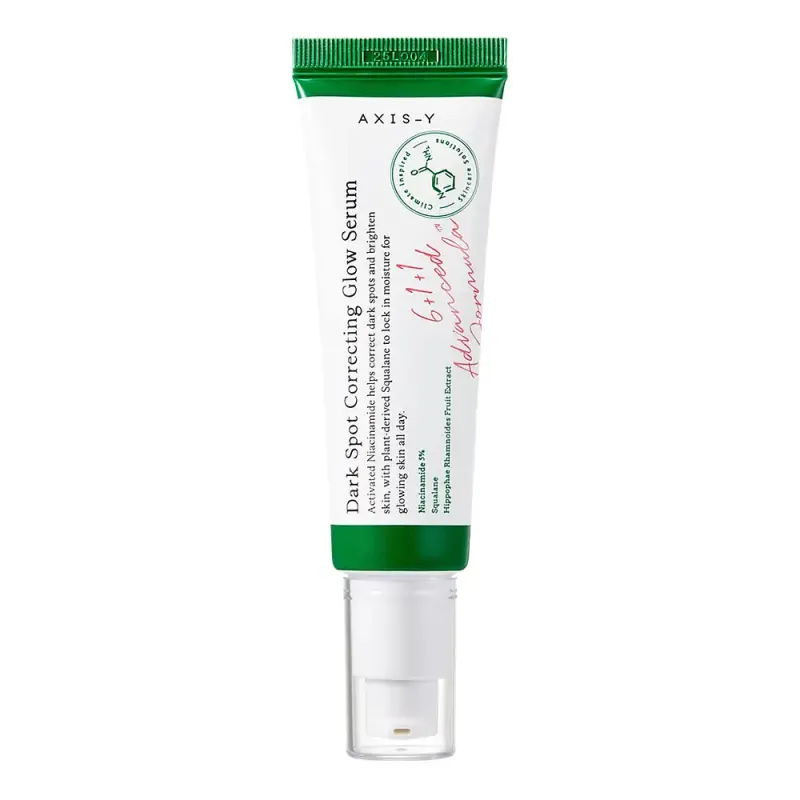
AXIS-Y Dark Spot Correcting Glow Serum by AXIS-Y
AXIS-Y

AXIS-Y Dark Spot Correcting Glow Serum

Serums

Safety score

Pregnancy-focused assessment

High Risk26/100
Higher concernLower concern

This formula contains a higher-risk ingredient in MamaSkin's current pregnancy-focused assessment.

Formula and assessment check

Ingredient safety review updated 9 December 2025. Product formulas can change, so compare the ingredients shown here with the packaging you have.

Report a formula mismatch

Ingredient breakdown

See how the listed formula falls across MamaSkin's pregnancy-focused risk bands.

24

No known risks

0

Low risk

0

Medium risk

1

High risk

Ingredients

Ingredients with a higher risk flag appear first, followed by the rest of the formula.

Rosmarinus Officinalis Leaf Oil

High Risk

Rosmarinus officinalis (rosemary) leaf oil is a concentrated fragrance essential oil with chemotype-dependent constituents (often including camphor/1,8-cineole). Pregnancy-specific evidence for topical cosmetic exposure is limited, and camphor-rich oils are commonly advised to avoid in pregnancy; combined with irritation/sensitisation potential, this supports a precautionary high-risk classification—especially in leave-on products.

Sources: CIR: Safety Assessment of Rosmarinus officinalis (Rosemary)-Derived Ingredients as Used in Cosmetics https://cir-safety.org/supplementaldoc/safety-assessment-rosmarinus-officinalis-rosemary-derived-ingredients-used-cosmeti-0; Dosoky and Setzer 2021, Maternal Reproductive Toxicity of Some Essential Oils and Their Constituents https://pubmed.ncbi.nlm.nih.gov/33673548/
Water

No Known Risks

Glycerin

No Known Risks

Glycerin is a widely used humectant that supports hydration and the skin barrier, with a long safety record and no known pregnancy or breastfeeding concerns in topical cosmetic use.

Sources: CIR; EU/UK Cosmetics Regulation

Show all (25)

Niacinamide

No Known Risks

Niacinamide (vitamin B3) is widely used for barrier support and tone/texture benefits, and is generally considered safe in pregnancy and breastfeeding when used topically at cosmetic concentrations.

Sources: CIR; EU/UK Cosmetics Regulation

Sodium Hyaluronate

No Known Risks

Sodium hyaluronate (hyaluronic acid salt) is used for hydration and cushioning, with very low systemic absorption from topical use and no known pregnancy or breastfeeding concerns at cosmetic concentrations.

Sources: CIR; EU/UK Cosmetics Regulation

Propanediol

No Known Risks

Solvent and humectant used to improve texture and ingredient solubility. Low systemic exposure expected from topical cosmetic use.

Sources: Cosmetic Ingredient Review (US); Scientific Committee on Consumer Safety (EU)

Erythritol

No Known Risks

A sugar-derived humectant or starch hydrolysate used to retain moisture and support formula texture. Cosmetic safety reviewers concluded that the assessed saccharide humectants and hydrogenated starch hydrolysate are safe in current practices. Dermal absorption of larger carbohydrate materials is expected to be limited.

Sources: CIR: Saccharide Humectants safety assessment; Hydrogenated Starch Hydrolysate final report, September 2015; CIR December 2025 Quick Reference Table https://cir-safety.org/sites/default/files/QRT-Update-Dec2025.pdf

Butylene Glycol

No Known Risks

Solvent and humectant commonly used in leave-on products. Not associated with pregnancy-specific concerns at cosmetic exposure levels.

Sources: Cosmetic Ingredient Review (US); Scientific Committee on Consumer Safety (EU)

Squalane

No Known Risks

Lightweight emollient used to support the skin barrier. Not associated with pregnancy-specific concerns at cosmetic exposure levels.

Sources: Cosmetic Ingredient Review (US); Scientific Committee on Consumer Safety (EU)

Oryza Sativa Bran Extract

No Known Risks

A rice-derived extract or wax used for skin conditioning, absorbency or texture. Cosmetic safety reviewers concluded that the assessed Oryza sativa-derived ingredients are safe in current cosmetic practices. Rice allergy remains possible in a susceptible person.

Sources: CIR: Rice-derived ingredients conclusions, IJT 25(Suppl. 2), 2006; December 2025 Quick Reference Table https://cir-safety.org/sites/default/files/QRT-Update-Dec2025.pdf

Calendula Officinalis Flower Extract

No Known Risks

A flower extract used for skin conditioning and soothing. Cosmetic safety reviewers concluded that Calendula officinalis-derived ingredients, including the flower extract, are safe in current cosmetic practices of use and concentration. Available testing did not identify significant systemic, reproductive or developmental toxicity at cosmetic exposure, although botanical sensitivity remains possible. No pregnancy-specific topical contraindication was identified.

Sources: CIR: Amended Safety Assessment of Calendula officinalis-Derived Cosmetic Ingredients https://cir-reports.cir-safety.org/view-attachment/?id=a9ee6359-8e74-ec11-8943-0022482f06a6

Carica Papaya Fruit Extract

No Known Risks

A papaya fruit extract used for skin conditioning. Cosmetic safety reviewers concluded that Carica papaya fruit and fruit-derived ingredients are safe in current cosmetic practices; this conclusion does not extend to papaya leaf extract, for which the available evidence was insufficient. No pregnancy-specific concern was identified for normal topical cosmetic exposure.

Sources: CIR: Safety Assessment of Carica papaya-Derived Ingredients as Used in Cosmetics, final 2025 https://cir-reports.cir-safety.org/view-attachment/?id=3ca24ad2-9f93-1b6c-a453-2da467b3c7c2

Hippophae Rhamnoides Fruit Extract

No Known Risks

A sea buckthorn fruit extract used for skin conditioning and antioxidant support. Cosmetic safety assessments of Hippophae rhamnoides-derived ingredients support current cosmetic uses, and no pregnancy-specific signal was identified for normal topical exposure. Botanical allergy remains possible.

Sources: CIR: Hippophae Rhamnoides-derived ingredients, IJT 36(Suppl. 3), 2017; CIR December 2025 Quick Reference Table https://cir-safety.org/sites/default/files/QRT-Update-Dec2025.pdf

Malpighia Glabra Fruit Extract

No Known Risks

malpighia glabra fruit extract is a botanical-derived cosmetic conditioning ingredient. The reviewed identity is not a concentrated essential oil or an oral herbal preparation. Available cosmetic evidence and expected topical exposure did not identify a pregnancy-specific contraindication, although botanical irritation or allergy remains possible.

Sources: CIR ingredient-specific and botanical-family safety assessments; CIR Quick Reference Table https://www.cir-safety.org/supplementaldoc/quick-reference-table-december-2025; European Commission CosIng

Polyglyceryl-10 Laurate

No Known Risks

Polyglycerin fatty-acid ester used as an emulsifier and solubilizer. Reviewed cosmetic safety references do not identify a pregnancy- or breastfeeding-specific concern for normal topical cosmetic use.

Sources: CIR cosmetic ingredient safety references for polyglyceryl fatty acid esters; EU CosIng / cosmetics regulatory inventory

Chlorphenesin

No Known Risks

Preservative used to help protect formulas from microbial growth. Reviewed cosmetic safety sources support present cosmetic use; no pregnancy- or breastfeeding-specific topical concern was identified in the material reviewed, although some users may still notice local irritation or sensitivity.

Sources: CIR: Safety Assessment of Chlorphenesin as Used in Cosmetics; EU CosIng / cosmetics regulatory inventory

Arginine

No Known Risks

Amino acid used as a humectant, skin-conditioning agent, and pH-adjusting support ingredient. Reviewed cosmetic safety sources support normal topical use, with no pregnancy- or breastfeeding-specific topical signal identified in the material reviewed.

Sources: CIR: Safety Assessment of α-Amino Acids as Used in Cosmetics; EU CosIng / cosmetics regulatory inventory

Ethylhexylglycerin

No Known Risks

Preservative booster and skin-conditioning agent. Considered safe for cosmetic use with low systemic exposure when used as intended.

Sources: Scientific Committee on Consumer Safety (EU); Cosmetic Ingredient Review (US)

Carbomer

No Known Risks

Polymer thickener used to create gel textures. Large-molecule ingredient with negligible systemic absorption.

Sources: Cosmetic Ingredient Review (US); Scientific Committee on Consumer Safety (EU)

Glutathione

No Known Risks

An antioxidant peptide naturally present in the body and used in topical products for skin conditioning and tone. Clinical studies and systematic reviews report generally good tolerance of topical glutathione, although evidence for cosmetic benefits remains limited. No pregnancy-specific topical signal was identified.

Sources: PubMed: Systematic Review of the Efficacy and Safety of Topical Glutathione in Dermatology https://pubmed.ncbi.nlm.nih.gov/41416233/; PubMed: topical oxidized glutathione clinical trial https://pubmed.ncbi.nlm.nih.gov/25378941/

1,2-Hexanediol

No Known Risks

1,2-Hexanediol is commonly used as a solvent and preservative booster; topical exposure is low and it has no known pregnancy or breastfeeding concerns at cosmetic concentrations, though very sensitive skin may occasionally react.

Sources: CIR; EU/UK Cosmetics Regulation

Hydroxypropyl Cyclodextrin

No Known Risks

A plant-derived carbohydrate polymer or modified starch used to thicken, stabilise or condition a formula. Cosmetic safety reviewers concluded that the supported plant polysaccharide gums and derivatives are safe in current practices of use and concentration. Loose powders should still be used without deliberately inhaling airborne particles.

Sources: CIR: Safety Assessment of Plant Polysaccharide Gums as Used in Cosmetics https://www.cir-safety.org/panelbook/safety-assessment-plant-polysaccharide-gums-used-cosmetics

Disodium EDTA

No Known Risks

Disodium EDTA is a chelating agent used to improve formula stability and performance; it is considered low concern in topical cosmetic use, with no known pregnancy or breastfeeding risks at typical concentrations.

Sources: CIR; EU/UK Cosmetics Regulation

Hydroxyethylcellulose

No Known Risks

Cellulose-derived thickener used to build viscosity and improve texture. Reviewed cosmetic safety sources support normal topical use, with no pregnancy- or breastfeeding-specific topical signal identified in the material reviewed.

Sources: CIR Quick Reference Table / ingredient status (Hydroxyethylcellulose, Final Report 03/2009); EU CosIng / cosmetics regulatory inventory

Allantoin

No Known Risks

Allantoin is a soothing skin protectant commonly used to help reduce irritation and support comfort, with no known pregnancy or breastfeeding concerns in topical cosmetic use.

Sources: CIR; EU/UK Cosmetics Regulation

Formulations can change without notice. For the most accurate result, compare this list with your packaging and scan the exact ingredient label in MamaSkin when you repurchase.

How to use this assessment

The risk band is the primary conclusion. The score adds detail within that band and should not be used to compare products as if a one-point difference were clinically meaningful.

MamaSkin provides pregnancy-focused information, not medical advice. Your midwife, GP, pharmacist or dermatologist should take priority when your circumstances differ from typical cosmetic use.

Read the full methodology